This question began a conversation which played on repeat in my head. It started when I walked into the gym, the boardroom, or the sanctuary. I silently asked it of my coach, boss, and pastor.
I couldn’t shake it.
It formed in my mind when someone spotted me on the bench press, as I shared a design concept to my team, and each time I considered voicing my same-sex attractions.
It stuck because it was more than a question. It was a declaration. Each time I asked it, I was actively telling myself I was inadequate, inferior, and unqualified. Those lies embedded deeper.
These three actions took the power out of it. Now, it rarely surfaces.
I decided to believe that what God says about me is true.
I let the question arise without attaching to it.
I chose different questions.
God made me. What he makes is very good. He has given me all I need for life and godliness. His strength is made perfect in my weakness.
I choose to believe those truths before walking into a room. I’ll bring them to mind, knowing they won’t always feel true. I’ll observe contradictory thoughts and questions and let them hang out without pushing them aside, while aligning my posture and intention with the truth.
And while I can’t always help the automatic questions that pop into my head, I can choose to silently ask different ones. I like these:
“You’re for me, aren’t you?”
“How can we succeed together? What can we create?”
“What are you needing right now?”
Finally, if none of that works, I’ll let the pesky question trigger me to turn to God and direct the question to him. I’ll get a resounding “No.” Whether it feels true or not, I’ll have seen His face and heard his voice.
Taking these actions will be a gift to others. They will enjoy the certainty I’ll bring to the room rather than an air of self-doubt. I’ll be primed to assure them of their worth and give them permission to set aside that common question. I’ll be open to the blessings they want to give me, not cheating them the opportunity.
Can you relate? What question do you want to ask instead of that automatic one?
“It’s that jacket you always wear,” my classmate replied.
Huh. My jacket.
My faux leather jacket I thought made me so cool was apparently a dead giveaway about my sexual inclinations and a determiner of my orientation. What a powerful piece of my wardrobe!
I don’t remember the rest of that interaction from college, but I didn’t leave it feeling empowered. I definitely wasn’t encouraged to take ownership of my identity. My favorite jacket became a straitjacket.
The name for my coaching business, Own Your Identity, has two meanings.The first and deepest meaning is to own who we are in Christ. To internalize it and request God’s power to live out of it. That is the foundation for growth and flourishing.
The second meaning is to own our sexual identity.
The truth is, other people, my feelings, and my wardrobe don’t get to tell me I’m gay, what orientation to identify with, or whether I should live out of my attractions to men. I decide whether to take on labels and what actions to take.
I used to let those outside voices bother me, but now I let them empower me.
I can appreciate my other well-meaning classmates who told me I was gay and recommended I accept it, because I see their desire for me to be whole and at peace when I was clearly troubled. I can be grateful for their care and concern while allowing the interaction to remind me to seek wholeness in Christ and provide an opportunity to clarify my values.
A culture which celebrates a multitude of sexual expressions can remind me to celebrate the truth of who I am in Christ, and how he designed my body to work and my life to flourish.
I can empathize with people who are uncomfortable with the unknown, want things tied neatly in bows, and don’t know what to do with someone who has attractions to guys but truly desires something else. I can choose to be comfortable being uncomfortable and enjoy practicing the faith required to not settle for a quick solution.
In response to the narrative that a life of misery is the fate of men who have attractions to guys but don’t embrace a gay identity, I can take peace knowing that as I give myself permission to make my own decisions, stay open to all possibilities, and walk courageously the road I am inspired to take, even if it feels uneasy, I am telling myself that I am strong and courageous and my future is not yet written. That brings life. And heck, I can change my mind whenever I want.
The arousal in my body and romantic feelings I’ve experienced towards other guys can beinformation rather than a declaration. I decide what to do with them. I’ve got options: I can act in alignment with my automatic attractions, I can let them hang out while I go about my day, or I can get curious about them, considering they may have a message for me, and invite God into the conversation and seek the counsel of others.
I can also acknowledge times I acted opposite of my values, but those actions don’t get to tell me what is true about me either and they don’t need to determine my next actions.
On a lighter note, I can enjoy being sharply dressed, knowing that I alone get to own my identity!
And better than any jacket, I can allow myself to be wrapped in God’s confident embrace. The one who breathed life into me and whose name all creation whispers.
I wanted to desire Christy. She was pretty and kind. We rode horses at her family ranch. Standing alongside a steed, her eyes held my gaze.
“Oh crap,” I thought.
My mind flashbacked to a high school girlfriend. It was fun to date her but frightening to kiss. Her lips were cold, clammy, and weak. I wanted to wipe my lips with my sleeve.
Will Christy be different?
Nope.
Get me out of here.
Why is this my life? Count me out.
But I couldn’t shake it. I wanted a woman. What was I missing?
Years later, my now wife would teach me to kiss.
“Jason, you are doing it all wrong.”
I was mesmerized as she instructed me.
What made the difference?
Here are my thoughts. I may be wrong, but it’s fun to theorize:
What I know is her lips weren’t clammy and cold. They were warm and inviting.
I leaned in rather than pulled away.
She was a mystery I wanted to discover more about. A kiss could accomplish that.
My mind was clear and my heart was open. I leaned in.
No doubt. No self. Curiosity and longing.
I was hooked.
I wanted to know her. She was unlike my sister, my mom, or past girlfriends. She was different than me. I liked that. I was enough for her and God was enough for us. No pressure. All fun. An adventure. I was up for it and qualified.
In a Sonic parking lot I kissed her.
“Not the best,” she said. Or something like that.
“Here’s how,” she continued.
I laughed. Then became a good student. Why not?
I had let go of expectation and accepted life as it was. I was enough and God was enough. I acknowledged my body’s inclinations while honoring my true desires and keeping an open hand.
I’m glad I did.
Now, we enjoy an intimacy I wouldn’t have imagined. I lose where I end and she begins. I desire to know her more and kissing her helps me do that. She desires the same.
She sees me and I see her. I am not alone. Neither is she.
I don’t question my manhood. I am like other guys. I don’t question my abilities. I have what I takes. I don’t question my true longings. I like women. I don’t need approval. God provides it.
I can risk rejection. It makes me stronger. I value vulnerability. Others are better off. I choose patience. It is worth it. The future isn’t written. I’ll let God write it. And I’ll live fully alive while I wait.
Because that is what I am called to do. When I live fully alive I know him more and am inspired to make him known. When I live fully alive I leave a mark, an impact, and a legacy.
So I’ll start now. In the paradox, confusion, and unknown. I’ll acknowledge where I’m at and solicit support. And I’ll love it all. Embrace mystery. The future isn’t written and the best is yet to come.
I said goodbye to a car I loved last night, standing in the cold as the tow hauled it away. This happened four days after it had finally become drivable again from a previous near total loss (which was a sordid tale itself I’ll tell you over coffee).
It was a late night and this morning is an early morning. My body is sore from getting jerked in my spinning car, I have a full plate of responsibilities ahead of me in my day job, and I’m finalizing the content for the masterclass this week which I believe will be a milestone for my growing coaching business and bring glory to God’s name and highlight the power of his word.
I’m tired.
Without having consciously decided, I believed my previous wreck happened TO me. I allowed it to drain my energy and time and dampen my spirit.
This new accident is going to give me a redo. I’m going to decide it is happening FOR me, not to me. I’m not sure how yet, but I believe it will GIVE me energy and time and RAISE my spirits. I’ve got to believe that. Because this week just isn’t going to work if I don’t.
I don’t have to feel the wreck is going to be a benefit, but I’m going to decide to believe that it is.
There are many hard things in life, present, past, and future, that I would not consider necessary or good.
I don’t have to believe the car accidents were good. I don’t have to believe the abuse I experienced as a child was good. I don’t have to believe my development of unwanted same-sex attraction was good.
But me and my present are valuable enough to decide to use it all to my advantage.
All my life, I’ve admired men who exhibit this quality: a confident sense of purpose.
It was a mystery to me how someone could show up fully present, comfortable in their own skin, clear on who they are, focused on a purpose, and not shy to express it.
I aspired to be steady, certain, and confident. What I knew was doubt, worry, and timidity.
When I looked at men who exhibited the qualities I aspired to, this is what I saw:
The opposite of me.
Their presence reminded me of what I believed I lacked.
I allowed admiration to trigger self-doubt. A disempowering cycle developed: Self-doubt fueled my hunger for approval. This heightened my focus on the men I admired, triggering more self-doubt, on repeat.
I was stuck.
It wasn’t my admiration that was the problem – it was what I allowed the object of my admiration to mean about me. Their steadiness told me I was unsure. Their certainty told me I doubted. Their confidence told me I lacked it.
In time, I learned to let the men I was attracted to remind me of my own strength, certainty, and purpose. When I see a man who appears to have a confident sense of purpose, I now say “I’m like him. And because I am a man of strength and purpose in Christ, I choose to grow.” I let other men be an inspiration to build upon my positive qualities rather than tear myself down.
When you see someone you admire, what do you say to yourself?
If you say, “I don’t measure up. I’m not like them,” try switching it for, “They inspire me to be better. How can I grow?”
The fact that I was created to make a unique mark in the world didn’t feel true.
Between you and me, one of my favorite songs features female vocals by a fox dressed in a green alien costume jumping on a trampoline. There. I said it.
I give the credit to my daughters who played Sing 2 on repeat.
The best part is the lyrics. They align with my desire to live each day to the fullest.
Don’t wanna live as an untold story
Rather go out in a blaze of glory
I wanna taste love and pain
Wanna feel pride and shame
I don’t wanna take my time
Don’t wanna waste one line
I wanna live better days
Never look back and say
It could have been me
I want to leave a legacy. I want to take steps with a confident sense of purpose towards a compelling future, and I want to feel each day along the way.
I used to believe that was a life I wasn’t qualified to live.
If I was truly authentic, people would be worse off because my brokenness would be known. If I loosened my composure, feminine mannerisms may be exposed and I could be judged as gay. If I acted like I had something unique to offer, others might have ready reasons to object.
Most of all, living fully and authentically just felt wrong. When I tried it, my mind and body reminded me with negative thoughts, heavy shoulders, a tight chest and shallow breathing that I was best in a supporting role with easy access to off-stage.
Now, the truth that I have unique purposes and am complete in Christ through his saving work on the cross isn’t just head knowledge. It is integrated into my being.
How did God bring me here?
My journey included a decision, followed by curiosity, vulnerability, and courage.
Before it felt true, I decided to believe that what God said about me was true.
Then, when my thoughts and feelings objected to living in alignment with truth, I got curious as to why. What was I afraid of? What was the lie I was believing? Where had the lie originated? I checked the evidence and most often found it lacking.
I vulnerably shared my insights with trusted friends and mentors. They grieved with me for the boy who was handed the lie “I am an observer,” as he was picked last in PE and sat on the bench. They saw my younger self who struggled against his father’s strength begin to believe, “I don’t have what it takes.” I borrowed their courage and felt their love when they said “me too” and “it’s going to be okay.”
Then, I took more redemptive risks. I let go of my limiting stories of the past and vividly imagined the future I felt God calling me to and allowed myself to feel the emotion of it. I aligned my current actions with the version of myself I envisioned in that future scene. And I realized I was that person all along.
Eventually, as I consistently lived aligned with the truth, my mind and body began getting on board. That has made life easier and allows me to focus my energy on living the life of impact and service God has for me.
And I choose to love it all. The joy, the grief, the shame, the tears, the hope, and the triumph. And I invite you to as well.
As a bonus, I’ll set an example of being courageously authentic by letting you know I don’t just love the lyrics to the song “It Could Have Been Me,” I love the video too. 🙂
Here is the link. Beware of the tap dancing furballs in the background. They are creepy.
A few years ago, I woke up one morning with the following question on my mind: “How can I ensure nothing bad happens today?” It was a question I experienced on repeat, often subtle, but always present. That day it was more pronounced.
I looked at the day ahead and considered the coworkers, friends, and family I would interact with and how my focus on self-protection would hinder my ability to connect, be mindful of their needs, and impact their lives. I wanted more for them and for me.
I can appreciate where my high value for security came from. I was vulnerable as a kid, confused as a teenager, and stunned by a nervous breakdown prior to college graduation. I doubted that I was okay and that things were going to be okay.
After college, God did an incredible healing work in my life. He gave me the courage to face abuse, depression, unwanted same-sex attraction, and sin. He blessed me with a family to love and protect. I was steady. Life was good. And I wanted it to stay that way.
But I also had a responsibility to inspire my family, set an example of courage and responsible risk-taking, and show them what God can do when we get out of His way. I wanted to leave a legacy for them and others. I wanted the next forty years of my life to be jam packed with rich experiences, changed lives, and a gaze that was consistently turned towards Christ’s.
I knew security needed to be taken down a few rungs from the top of my value ladder. I decided to replace it with values that would give me the life I felt called to. You may make fun of me for what I did next.
I walked into my favorite coffee shop with a journal and a printed list of values. After ordering my latte, I scanned the list and ranked them 1-10. Am I the only person that does stuff like this? Maybe so. But I’m glad I did.
Here was the list:
Love
Success
Freedom
Intimacy
Security
Adventure
Power
Passion
Comfort
Health
When I read them, security felt dull compared to the rest. Adventure and passion had flashing lights around them and little signs saying “pick me!”
So I did.
I cleared them with God and considered them daily.
I began raising my hand to take on new opportunities. I spoke up more often. I saw obstacles as stepping stones to new levels of adventure. And last year, when the idea entered my mind to create content for men experiencing unwanted same-sex attraction, I acted on it rather than dismissing it.
Since then, God has prompted me to step out more publicly with my story, coach men who are allowing their unwanted attractions or lesser desires to hold them back, and collaborate with other counselors and coaches. I have consistently said yes and I’m having a blast.
Are there any values that no longer serve you? Consider how you want your life to look in the years to come, take inventory of your values, try on some new ones, and let God take it from there.
We don’t need to wait for us or our circumstances to change before allowing ourselves to feel good, accept ourselves and love life. In fact, waiting for those things is a hindrance to our growth. It has been for me in my journey.
I used to believe feeling good was dependent on outside forces. I remember wanting a guy to befriend me so I could not just be accepted but to feel acceptable. I wanted to be more muscular not just to be physically stronger but to feel like a strong person. I hoped my unwanted same-sex attractions would go away and opposite-sex attractions would grow not just so it might be easier to develop a relationship with a woman but so I could feel capable of one.
It was fine to want friends, a stronger body, and romantic feelings towards women, but often what I wanted more was the feeling I believed those things would give me. Life would be more enjoyable if I felt acceptable, strong, and capable. I would no longer have to feel alone, weak, and unqualified. I would do almost anything to avoid those feelings. I didn’t realize that I could choose to feel empowered whenever I wanted, regardless of external circumstances, my achievements, or whatever my default thoughts and emotions were telling me.
I remember getting invited to dinner with some other freshman guys from my dorm. They joked around as we walked to a popular hangout, and when we entered, they confidently raised their voices to hear each other over the crowd. I was quiet when we were walking and overwhelmed when we got to the packed restaurant. I wanted to feel at ease, confident, and free but I didn’t know how.
So my brain made some suggestions. First, it raised the question, “If these guys feel confident and free and I don’t, what do they have that I don’t possess which allows them to feel that way?” (If you’ve read my previous posts, you’ll spot that as a flawed question). Then, my brain began taking an inventory: The other guys were bigger than me, always had something to say, and didn’t break eye contact when a girl looked their way. They didn’t doubt that they belonged there.
I felt overwhelmed, alone, intimidated, and discouraged. But if developing the qualities they had is what it would take for me to feel confident, worthy, and comfortable, I was all in. The problem is by focusing on that list of perceived shortcomings, I was telling myself that feeling good, accepting myself, and enjoying life in the moment had requirements for entry that I hadn’t met. At the time, I was blind to that being a lie.
I was in the habit of living that way. I collected standards and expectations of myself to achieve in the future so that I could enjoy the present. But I never reached the end of the list. I was constantly raising the bar and adding more items. I wasn’t experiencing life. I was in a holding pattern until I earned the right to live it fully.
When I look back on that restaurant scene, I grieve for the version of me who shortchanged himself the opportunity to enjoy a rich college experience – being a part of a group of new freshmen walking into a popular hangout filled with tons of different people and soaking it in. What could have been an evening of discovery became a place of anxiety that I wanted to escape from until I could return as a more attractive, confident and opposite-sex attracted version of me.
What I realize now is that I don’t have to wait to feel good and enjoy life. Here are a few tools I use when I find myself postponing joy and standing on the sidelines.
Tools to Live Fully Now
Get Comfortable Being Uncomfortable
We can all feel scared in new situations. We may feel compelled to escape. That’s okay. We don’t have to be without fear or insecurity to enjoy ourselves. We can observe the list our brain may start creating of how we don’t measure up and how we need to change. We can acknowledge our emotions, thoughts, and attractions and choose to look at them productively as they occur or save that processing for later and practice enjoying the present moment regardless. We can be uncomfortable AND choose how we want to feel and how we want to experience the moment.
The same applies to starting the growth journey of navigating unwanted same-sex attractions. It can be scary and uncomfortable to look at a part of your life you may have put effort into avoiding, but the work is worthwhile and rewarding. So, get comfortable being uncomfortable. Be ready to do some deep work, but don’t make the mistake of believing the work is a requirement to feel complete or experience a life of joy. Decide you will be grateful for life as it is, love yourself, and the process, and invite Christ into it.
Give Thanks
We can thank God for the opportunity to walk into something new, take a courageous action, and embrace vulnerability in the moment. Gratitude and fear can’t coexist.
Get Curious and Take Action
We can look at the list of requirements and expectations our mind creates and get curious about what may have inspired them. Then we can honor the healthy things we long for, choose to find evidence of their existence in our lives already, and consider how we might develop them more in God’s timing.
Impact of this Mindset
Now I can walk into an overwhelming situation and simply observe my emotions, thoughts, attractions, and my brains attempt to escape them. And while that is going on, I can also appreciate the new scene, the dynamic people in it, and enjoy the possibility that something really cool could happen when I step into a crowd both scared and brave. And I can love it all.
When I begin coaching someone who feels overwhelmed by same-sex attractions, I invite them to look at their life, the good and the bad, what they are both satisfied with and what they don’t like and decide to love it all. Growth is a never-ending process. If we don’t choose to love ourselves and life at the beginning of our growth journey, we won’t know how to love them once we are further along the path. Also, there is no better motivator than love.
Carl Rogers said, “The curious paradox is that when I accept myself just as I am, then I can change.” This can apply to accepting our circumstances and progress along our growth journey also. Doing deep personal work from a place of joy, strength, acceptance, and love will propel you further and make the process more enjoyable, even when moving through grief, hurt, and loss.
Embracing this mindset allows me to enjoy the present moment and confidently engage in the hard work of personal growth and change. I know that life doesn’t wait—and neither should we. God has given us His presence to enjoy now, gifts to be shared now, and his gospel to be spread now.
Are you in the habit of waiting until you or circumstances look different before allowing yourself to feel good and love life? If so, continue the work of sanctification and growth, but receive God’s love now, just as you are. Strive towards a better tomorrow, but love God’s gift of today. Get in the habit of it.
Evidence of the Gospel
Finally, when I think of how easy it is to create a list of things to do before we can allow ourselves to embrace life, it reminds me of the power of the gospel. The Bible says that “While we were yet sinners Christ died for us.” He doesn’t give us any prerequisites to meet before coming to Him to invite His fullness of joy and radical love into our life. Let’s follow His example and treat ourselves the same way as we live this beautiful and messy life He allows us to walk.
If you listen to or read my testimony, you will have a picture of the day during my fine arts class freshman year of college when I had the largest sexualized attraction to a guy in my life. I believe my body and mind were telling me that connecting physically with my classmate was the answer to my nagging questions, “Am I okay and will everything be okay?” The problem was, I didn’t want to be sexual with him.
Those strong sensations and emotions were evidence of the sexual attraction and romantic feelings I experienced toward guys. But what evidence was there of the desires I consider to be authentically me?
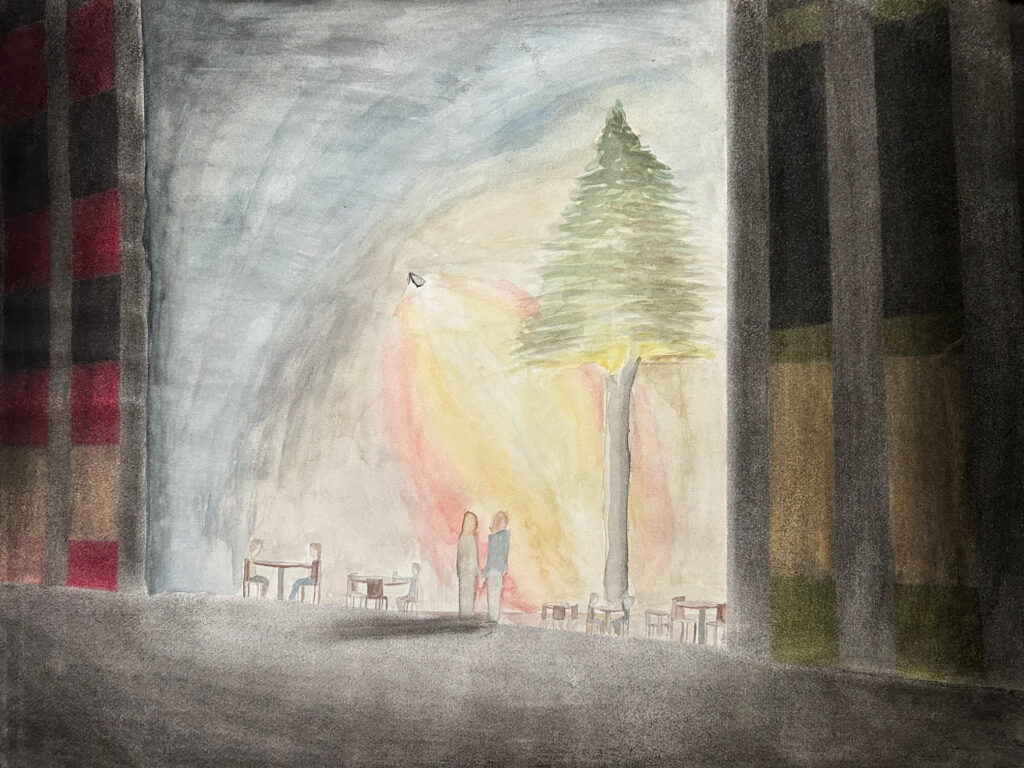
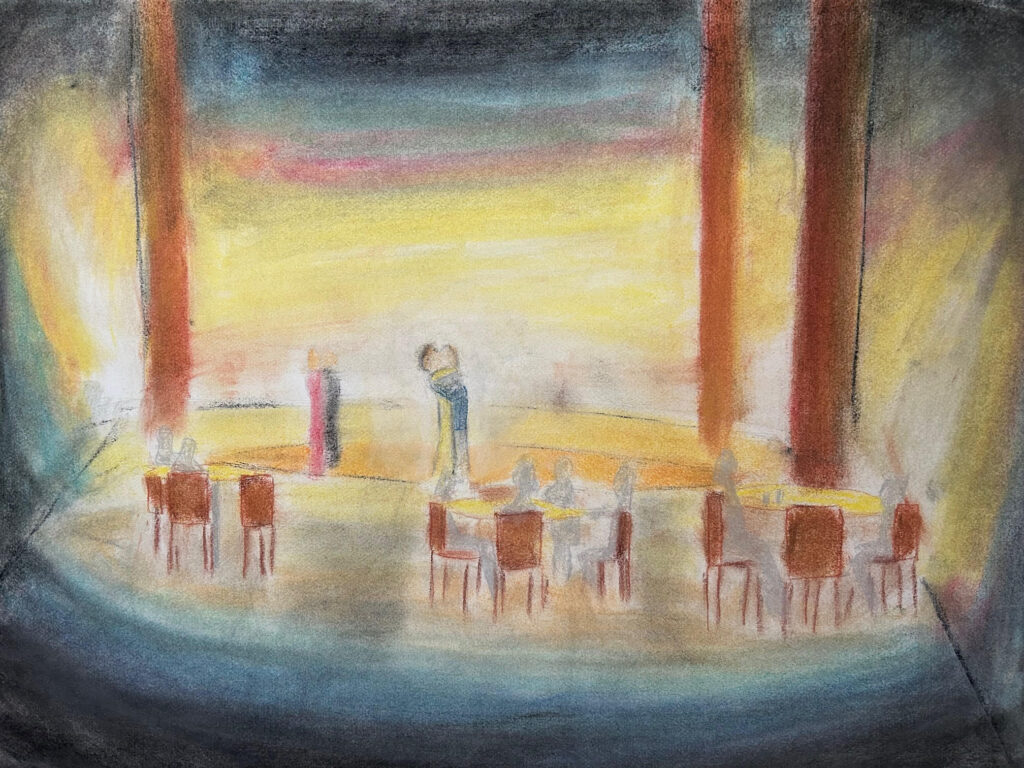
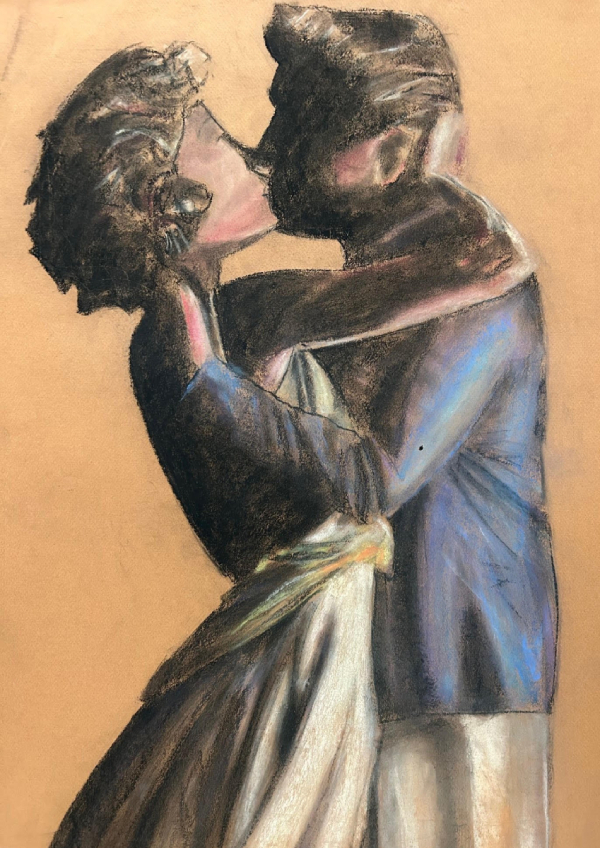
Last weekend, I rediscovered my portfolio of drawings from architecture school and opened it to share with my kids. I hadn’t looked at it in twenty years and had forgotten it included my final project from that fine arts class. My drawings illustrated scenes I found intriguing and mysterious at the time. I’ve included photos of them below.
A young man and woman walk along a quiet street, hand-in-hand. His steps are confident and sure. He squeezes her hand when they catch a glimpse between the mid-rise buildings of changing lights pulsing to faint music.
She is just stunning. Her flowing dress hangs delicately from her smooth shoulders. She catches his gaze and smiles. She turns her attention to the upcoming scene and this time she is the one to squeeze his hand.
They enjoy a magical night. On the dance floor, her hand rests on his shoulder and his solid grip steadies her waist. He moves toward her. She steps backwards, trusting this man who knows who he is and the life he can offer her.
I wanted to be that man who had a strong frame for a woman to steady herself against. I wanted to walk with a mesmerizing woman, knowing there would always be something more to discover about her.
That was my true desire. My sexualized attachments to guys weren’t something to ignore, but they didn’t deserve to dim or disqualify the beautiful vision I enjoyed bringing to life on paper.
If I could speak to my younger self who had no clue how to move forward with his desires in conflict, I would say, “Love your vision. Don’t hold back from imagining the life you want in vivid detail. Allow yourself that pleasure. Your other desires won’t hurt you. They are present but not powerful. Let them be something you gain strength by learning from. At the same time, move towards the life you want without hesitation. I’m here for you. You’ve got this.”
For many years, my automatic beliefs didn’t serve me. I believed I didn’t have what it takes to make it in life, that the world was a scary place, and that others were better off with me on the sidelines. These beliefs kept me from enjoying the fullness of life and showing up as my authentic self, uniquely created for God’s kingdom purposes. With those beliefs, I would find myself detaching from life and giving my power to others.
I like this belief I chose much better: I am complete in Christ, with limitless potential when I submit to His leading.
Where did my false beliefs come from, and why did they feel so true? How did my beliefs change? I’ll share my understanding of it. As you read, consider your beliefs. Decide whether they are true and empowering and ask God to make His truth feel more real than the lies.
Belief Formation
Beliefs are typically shaped in one of two ways:
1. Our personal experiences, assumptions, and reasoning.
2. Accepting what others tell us as truth.
Most of our core beliefs are established during childhood. At this stage, we are highly impressionable and seek meaning in nearly everything due to our innate curiosity. At a young age, we rarely question our interpretation of experiences and often accept what we are told as fact.
In addition, when those experiences or words are emotionally charged, resulting beliefs embed deeper and require more work to replace.
Types of Beliefs
Beliefs can be categorized as either global beliefs or rules.
Global beliefs are overarching and affect many areas of our lives. My belief that the world is a scary place is a perfect example! With that belief, I was on guard, prioritized safety, and avoided risk. I missed out on much of what life had to offer and limited my potential.
Rules are specific criteria that dictate our behaviors. For example, because the world is a scary place, when someone tells me what to do, I must say yes to avoid losing their approval. Or, when an opportunity comes up, it is better to let someone else go first to avoid risk.
Belief Formation
Here is an example of belief formation in my life:
I’ll never forget the wrestling matches my dad had with me. If you follow my content, you’ve heard me talk about them. They were emotionally and physically charged. My brain worked overtime trying to make sense of them.
My dad introduced wrestling as a favorite pastime of fathers and sons. But it always turned one-sided. Shortly after we began, I would find myself pinned between his legs struggling to obey his command to break free. My strength was no match for the force he used and I had no choice but to give up. But he didn’t stop. He repeated “C’mon!” I would push again but his legs just tightened more. I wanted to please him and enjoy connecting with him but his demand became increasingly unrealistic. Losing was the only option he gave.
I remember feeling confused, angry, afraid, and sad.
I thought to myself: I don’t understand how I am supposed to win. Does he think I should be able to? Maybe something is wrong with me. What will it take to make him happy? Am I really supposed to enjoy this?
The contrast between me and my dad seemed significant. He was all powerful and I was weak. He got to make the rules. My voice didn’t count.
I can see how my interpretations of that experience and the answers that I (or the enemy) gave to my questions contributed to the following global beliefs:
I am not strong enough.
I am not like other men.
My voice doesn’t count.
My best effort is not enough.
I am someone who loses.
I am alone.
Rules that took root were:
When a challenge is placed before me, I have to push beyond what is reasonable, and I can’t trust myself to know what’s reasonable.
If I don’t keep doing what someone wants, I won’t be loved.
How the Mind Works
My young mind was trying to make sense of a confusing situation. It was trying to decide what the experience meant about me, other people, and the world. It didn’t know how to be neutral. It had to apply a meaning to it.
Our Brains are Meaning-Making Machines
Our brains constantly interpret and assign significance to information we receive. This helps us make sense of the world, but our brains don’t always get it right. It may misinterpret information or rely on incomplete data, leading to false beliefs or misconceptions.
I assumed my dad was like most other men, so I generalized my view of men based on my experience with him. I took his word as truth when he said other boys enjoyed wrestling, which meant I was not like other boys. It was apparent I was not a good judge of what was right or reasonable, which meant I must rely on the judgment of others.
Building Legs of a Stool
Whatever hypothesis our brain makes of a situation, it is compelled to find support for it, like building legs on a stool.
When I believed I was unlike other boys, it was easy to find evidence it was true. They never missed when high-fiving each other. My aim was off. Other boys didn’t hit the soccer ball into the wrong goal. I watched from the bench.
When I did see evidence that I was like other guys, I dismissed it as a one-off.
Impact of Beliefs
Beliefs direct our focus, drive our thoughts and actions, and open up or close opportunities.
Beliefs Direct Focus
Beliefs act as a filter for our attention, honing in on information that aligns with what we have accepted as true.
If I don’t believe I’m okay as I am and can’t trust myself to know what’s reasonable, I will turn my focus to other people to give me the rules of life. I’ll seek validation from them and try to figure out how I need to be. I did this a ton! I looked at other guys and imagined what I needed to do to call myself a man. It didn’t occur to me that I was already acceptable. I copied the confident appearance of my classmates and coworkers while never letting myself measure up.
Empowering Beliefs Open Doors
When I walk into a room knowing I’ve got what it takes for any task God places before me, I’m more likely to make eye contact with people that could intimidate me, approaching them with a posture of discovery and appreciation, and be open to opportunities that may come up.
False Beliefs Limit Possibilities
Disempowering beliefs can bias our mental filter, causing us to overlook opportunities and potential solutions by labeling them as irrelevant or beyond our capabilities. If I was convinced I wasn’t qualified as a man, why would I take on a task I believed only a real man could do? Then, by not stepping boldly into the masculine realm, I reinforced my place as an observer of it.
The thought, “I won’t be able to handle this,” could easily arise, inviting feelings of defeat, detachment, and helplessness. I don’t like those feelings or the results they bring, but allowing them is often easier than fighting for different beliefs.
How to Integrate New Beliefs
To change your life, you need to identify limiting beliefs that no longer serve you and replace them with empowering beliefs.
Integrating new beliefs into our daily life goes beyond simply telling ourselves what we want to believe; it requires consistent practice and reinforcement until they become automatic. This process involves engaging our emotions, repeatedly exposing ourselves to the new beliefs, and creating habits that support them.
Below are practices I have found helpful in questioning and changing my deeply held beliefs. Consider what may work for you to embed beliefs that align with God’s word.
1 – Check the Facts
State the limiting belief, then ask: What is the evidence supporting it? What is its source?, and What does God’s word say?
Evaluating the evidence helps to distinguish between assumptions and facts. Understanding a belief’s origin is key in assessing its reliability and intent. Holding beliefs up to the light of God’s word allows us to discern if they are in alignment with the truth.
When I considered the faulty evidence that formed the legs of my false beliefs that I was weak, someone who loses, and dependent on others for validation, the beliefs began to wobble. Being overpowered by my father didn’t mean I was weak or a loser, it meant that I endured pain as a young man and was strong for moving through it. The impossible challenge to break free from my dad’s grip was not a good determiner of my ability to win in life. God’s word says that I can do all things through Christ who gives me strength.
My dad was often a poor source of truth about me. A good father consistently points their son to the Creator to reinforce their identity as image bearers of Him. I believe it was Satan, the father of lies, who used this gap in my training to direct my focus to other people for validation rather than the Giver of Life.
God’s word is clear that in Christ, we have strength in weakness, abounding love, and are more than conquerors:
Romans 8:37-39 states:
“No, in all these things we are more than conquerors through him who loved us. For I am convinced that neither death nor life, nor angels nor rulers, nor things present nor things to come, nor powers, nor height nor depth, nor anything else in all creation, will be able to separate us from the love of God in Christ Jesus our Lord.”
2 – Clarify Your Purpose
I took time to get clear on what I wanted my life to look like, in line with God’s will, and what I needed to believe to make it happen. This allowed me to target lies that were getting in the way of my purpose and motivated me to get clear on the truth and live aligned with it.
Below are four questions I pose to men to help them uncover limiting beliefs and prompt new answers to live an empowered life aligned with their vision and God’s truth: What does it mean to be a man?, What is my place in the world?, What do I have to offer others?, and How does God see me? Consider beliefs that come to mind when you ask those four questions. Identify which are empowering you and which are holding you back. Note any patterns that emerge.
To illustrate this, I’ll share my unconscious beliefs stemming from physical abuse that included the wrestling matches with my dad, along with the new beliefs I consciously chose.
1 – What does it mean to be a man?
Unconscious Beliefs:
To overpower others.
To never admit defeat.
Beliefs I chose:
To create, serve, and give from a place of love.
To take action aligned with God’s will even if scared.
To reduce the suffering of others.
To invite others into the loving presence of Christ.
2 – What is my place in the world?
Unconscious Beliefs:
An observer. I belong on the sidelines, watching others play full out in life. I’m not qualified.
Separate from men.
Disconnected from myself and my body.
Beliefs I chose:
I can feel comfortable in my own skin. I can be at home anywhere, believing others are better off in my presence because it reflects Christ.
I belong wherever God places me and I bring great value.
3 – What do I have to offer others?
Unconscious Beliefs:
I’m too weak to offer much.
I need to get what I believe I’m missing before I have anything to give to others.
Beliefs I chose:
What I have to offer others is limitless. Whatever God decides for me to grow into and give. 1 Corinthians 2:9 states: “But, as it is written, ‘What no eye has seen, nor ear heard, nor the heart of man imagined, what God has prepared for those who love him.’”
4 – How does God see me?
Unconscious Beliefs:
God is unmoved by my suffering.
I am not worth helping.
If I see myself as weak, maybe God does too.
Beliefs I chose:
As His beloved son.
Perfect through the work of Christ.
A partner in His mission.
Lovable, strong, capable, and courageous.
My Purpose Statement
Recently, I prayerfully crafted a purpose statement that I review each day:
I am someone who believes in the power of truth to clear away the fog that veils the fullness of life God intends for us, someone who never gives up on anyone, and gives generously out of
abundance.
I foster clarity of purpose, build courageously, prioritize growth, and help others to live fully alive. I empower my family, community, and clients to choose a life activated by the work of
Christ, for God’s glory and their greatest joy, prioritizing knowing Christ and making Him known.
3 – Embrace Emotion
Experiencing strong emotion while integrating new beliefs gives them impact. Emotions act as powerful catalysts for change, helping to make new beliefs feel more real and significant. Emotional engagement not only accelerates the adoption of new beliefs but also makes the process more meaningful and motivating. Here are ways to do this:
Visualization
Spend time daily visualizing your new beliefs and the life that comes with them. Engage all your senses and emotions, feeling the joy and excitement as if it’s already happening.
Before I stepped into being more public with my story, creating content, and coaching men to live beyond their unwanted attractions and negative habits, I envisioned myself doing it. I imagined working with men through the curriculum I was developing and felt the joy that would bring. This communicated to my mind that it was possible, I was capable, and that courage brings joy.
Affirmations with Emotion
Create affirmations for your new beliefs and say them out loud with strong, positive emotions. Feel the conviction and enthusiasm as you repeat them.
When Tony Robbins was young, he would repeat this phrase to himself while running: “Everyday in every way I’m getting stronger and stronger!” It’s a little cheesy, but it strengthened his belief that he could be more than what was modeled for him or expected of him. He believes in the power of integrating movement, energy, and voice in solidifying new beliefs.
If you had watched me and my son on the trampoline last year, you would have either laughed or been inspired as we chanted that same phrase to the night sky, my son on my shoulders and me taking bounding steps in a circle along the protective netting. Whether those words sank into us or not, we had a blast.
Practice Gratitude
Reflect on moments where your new beliefs have positively impacted your life, no matter how small, and allow yourself to feel gratitude and fulfillment.
I can thank God for both my strength and my weakness. My strength is a reflection of His image. My weakness invites His strong presence.
Emotional Anchoring
Use a physical object, like a bracelet or a coin, to anchor your positive emotions. Each time you touch or see this object, take a moment to immerse yourself in the empowering feelings associated with your new beliefs.
Grieve
The Psalms are filled with lament. David repeatedly poured out his emotion to God in faith, inviting Him into his pain and trusting God to turn his face back toward the truth.
I have shed tears of loss, regret, and shame. I grieved the loss of connection with my father, the results of my poor choices, and opportunities I missed when I was too scared to raise my hand.
I didn’t know what was going to be on the other side of those tears. I found out it was courage, strength, resilience, and hope. When I shared my lament with others, the benefits multiplied.
Get Angry
Sometimes, you’ve got to get mad. I tapped into my power when shouting at an empty chair I imagined my dad sitting in. I was in the company of trusted men. I told my dad what my six year old self couldn’t. “You hurt me. I hate you. I am stronger than you know.” I had to give myself permission to do that.
Years later, when my dad was hurting, I was able to use my unquestioned strength to tell him, “I love you. I’m here for you. You’re not alone.”
Use Pain and Pleasure
Associating pain to limiting beliefs and pleasure with new, empowering beliefs is a powerful strategy for personal transformation.
By vividly linking negative emotions and consequences to our limiting beliefs, we create a strong aversion to them. For example, if I hold the belief that I’m not good enough, I can imagine the pain and regret of missed opportunities and a life unfulfilled due to this belief.
On the other hand, by associating pleasure with new beliefs, like viewing oneself as capable and deserving of success, we align these beliefs with positive outcomes. When we tie positive emotions, such as joy, excitement, or a sense of achievement, to our new beliefs, it reinforces neural pathways, making these beliefs stronger and more accessible. Think of creative ways to do that in your life.
4 – Step Out of Your Comfort Zone
“Life begins at the edge of your comfort zone.” – Neale Donald Walsch
When your new beliefs take you to the edge of your comfort zone, your mind asks “Is this safe?,” “Is change worth the risk?” Take one step over the line to respond yes. Fear may arise. Be ready to respond with courage. You are telling yourself you are someone that has a vision strong enough to challenge old beliefs and live out of new ones. It will take a while for your nervous system to catch up.
It took many times raising my hand to take on a leadership task in a group filled with qualified men before my fear was edged out by gladness. But each time I did, I confirmed my identity as a strong, successful leader. That belief began to feel more true.
Consider what uncomfortable places you could allow your beliefs to take you. Maybe it is walking into the gym, learning a sport, speaking up to your boss, or sharing your unwanted attractions or negative habits with a friend.
5 – Get Vulnerable
Years ago, a new mentor sat across from me at a restaurant patio and asked if I’d been abused. He said that something I shared caused him to raise the question. I paused. Stating it out loud would make it real and shut the door on any fantasy that it wasn’t part of my life. But I would be able to stop holding my breath.
When I answered yes, my body both sighed and became alert at once. Nearby conversations muffled as I awaited his response. I had breached my comfort zone and stepped into vulnerability.
When he listened openly and validated my experience, I could no longer say I was alone. By sharing my abuse, I showed my strength. My belief that I was weak and separate from others had evidence stacked against it.
Over the years, I have developed relationships with people who confirm what is true and are faithful to walk beside me as I work to integrate new beliefs. I share my dreams, longings, and fears with them.
Vulnerability is hard, but it’s worth it. It is a gift for you and those who receive it. Surround yourself with people who affirm what is true about you and magnify your life of purpose and possibility.
6 – Honor Your Younger Self
Honoring your younger self can be a powerful and transformative practice when working on changing limiting beliefs. By acknowledging and validating the experiences and emotions of your younger self, you create a compassionate and understanding relationship with the past. This process helps to reduce self-criticism and judgment, allowing for a more open and accepting mindset. It fosters self-compassion, which is crucial for healing and growth.
Recognizing that the limiting beliefs were formed as a way to cope or make sense of the world at that time enables us to release any shame or guilt associated with them. Instead of seeing those beliefs as flaws, we can view them as protective mechanisms that once served a purpose. This shift in perspective makes it easier to let go of the old, unhelpful beliefs and embrace new, empowering ones.
Consider writing a letter to your younger self as a way to honor the part of you that needs encouragement and care. Read the letter I wrote to my younger self when he was confused by his dads behavior and feeling alone here.
Something Greater
The struggles we face with limiting beliefs and false narratives in our lives point to a greater spiritual battle that Christ has already won. In His love and sacrifice on the cross, Jesus dismantled the ultimate falsehood of sin and death, offering us freedom and truth.
If you find yourself burdened by limiting beliefs, consider turning to Christ, the author of truth and salvation. Embrace His victory and allow His love and truth to liberate you from the chains of falsehood, guiding you toward a life of purpose, freedom, and eternal hope.
Three Core Beliefs
As you can see, the beliefs we hold deeply influence our actions, perspectives, and overall well-being. I’d like to leave you with three core beliefs I believe significantly contribute to living a life of purpose and fulfillment:
“I am complete in Christ.” This is a result of the transforming power of the gospel. While it is a concrete truth, I don’t always feel it or live like it is. God is gracious to remind me of it.
“Life is happening for me, not to me.” This is a catchy version of what the Apostle Paul states in Romans 8: “And we know that in all things God works for the good of those who love him, who have been called according to his purpose.” It transforms my obstacles into opportunities.
“I can make a difference.” Belief in one’s ability to make an impact in the world through the power of Christ and for His kingdom fuels decisions in line with His will and our identity and purpose.
Remember, your beliefs are not set in stone. You have the power to reprogram your mind and create a life that genuinely reflects your potential. Know that God is for you and is in your corner. So am I.
I’ve shared before the scene where my dad would pin me down during an activity he called wrestling and urge me to break free. But his grip rendered me powerless to exert force against him. I would try to obey his command but eventually give up. It was an impossible and confounding task.
In my coaching program, we choose a scene from our life and write a letter to ourselves in it. This is the letter I wrote to my eight-year-old self who wanted to please his dad and show his strength.
Read my letter to Little Jason below. I pray it will give you permission to honor your story and let your younger self know they are seen. Doing so will empower you in the present and open your heart to love yourself, God, and others more.
Little Jason,
You are strong. Don’t believe otherwise. What your dad is doing is not right. Dads are supposed to create experiences that make you feel big and strong, not small and weak.
You want to please your dad and make him proud. You want him to look at you with admiration, respect, and care. I honor that in you. You are not the reason you aren’t receiving those things. It’s him.
Believe my words: You have great worth and value. You are not alone or forgotten. You haven’t met them yet, but there are so many people in the world that will confirm that in you.
Over the years, I’ve had to grieve the loss of the dad I hoped for. You want a dad you can depend on. You should have it. But our dad isn’t reliable. God can transform anyone, but your job right now is to believe God made you for a unique purpose and loves you to the moon and back. It is true, no matter what anyone says or does.
I wish I could make hurtful words and actions bounce off you rather than sink into your mind and heart. I’d like to stand in front of you with my arms out to guard you.
Know that it isn’t your job to make dad happy even though he may tell you it is. A lot of things he says aren’t true. I know that is confusing. I’m sorry.
Little Jason, there is so much richness to life available than what you know now. Soon you will have a desire to write but you’ll think it is selfish to do so. It’s not. Believe that God wants you to lean into your interests and use them for His glory.
God doesn’t just love you, he likes you. He likes you a lot. Just like me, He would love to hang out with you. He wants to know what you are thinking and feeling. He wants to encourage your curiosity and wonder and hear all about it. God’s got all the time in the world and has no agenda except to love you.
God created you strong. Strength is not something outside of you, beyond your reach. It permeates you. I admire the strength you showed when you told your dad he hurt you. His reaction doesn’t discount it. Feeling helpless, confused, or defeated doesn’t mean you are weak. They are opportunities to allow God to remind you of your strength and let you borrow His.
I asked a friend recently, “If you are vulnerable with someone and get hurt, is it worth it? Is it possible you could be better off for being vulnerable even though the outcome wasn’t what you desired?” He responded, “No, I have been hurt enough.” My heart broke for him.
I get it. It is hard to put yourself out there not knowing what you’ll encounter. My heart was heavy for him not only for the hurt he experienced but also for the aliveness he is missing out on by prioritizing protection. I want more for him and for myself than self-protection offers.
In life, we know that acceptance and reciprocation of vulnerability are not always encountered. It has been easy for me to keep my cards close to my chest out of fear of being hurt, but doing so kept love and connection at arm’s length.
While we want to be wise and not “throw our pearls before swine,” healthy risk without expectation is empowering. The practice of being vulnerable is a reward in itself. It leads us to become more connected, compassionate, and confident individuals. Below are tangible benefits:
1. Empowerment Through Action
Building Confidence: Each act of vulnerability builds inner strength and confidence even if it isn’t reciprocated. By taking proactive steps, we gain a sense of control over our actions and emotions.
Personal Growth: Over time, these repeated efforts contribute to personal growth. They help confront and overcome fears, thereby fostering resilience and adaptability.
2. Emotional Intelligence
Self-Awareness: Practicing vulnerability enhances self-awareness. It allows us to be in touch with our emotions and understand our reactions better.
Empathy Development: These practices foster empathy, as being vulnerable helps us appreciate and validate our own and others’ emotional experiences.
3. Internal Benefits
Authentic Living: Consistent vulnerability practice aligns with living authentically. It reinforces that being true to ourselves, aligned with our identity in Christ, is invaluable, irrespective of external validation.
Reduced Fear of Rejection: Regular exposure to vulnerability reduces the fear and sting of rejection over time. It normalizes the experience and builds a thicker emotional skin.
4. Healthier Relationships
Breaking Barriers: Vulnerability breaks down emotional barriers, promoting deeper and more meaningful relationships.
Trust Building: Even if not every attempt is reciprocated, those that are will be built on genuine trust and connection.
5. Mental Well-Being
Emotional Release: Expressing vulnerability is a form of emotional release, reducing internal stress and promoting mental well-being.
Positive Reinforcement Cycle: Each positive experience, no matter how small, can create a positive reinforcement cycle that encourages further attempts at connection.
In her most famous TED Talk, Brene Brown, Author of Daring Greatly: How the Courage to be Vulnerable Transforms the Way We Live, Love, Parent, and Lead, says this:
“This is what I have found: to let ourselves be seen – deeply seen, vulnerably seen – to love with our whole hearts, even though there’s no guarantee, to practice gratitude and joy in those moments of terror, when we’re wondering, ‘“Can I love you this much? Can I believe in this passionately? Can I be this fierce about this?,’ just to be able to stop and, instead of catastrophizing what might happen, means we can say, ‘I’m just so grateful, because to feel this vulnerable means I’m alive.’”
Let’s keep pushing forward in vulnerability, knowing that every step we take in vulnerability and connection is a step toward greater empowerment and authenticity.
The psalmist said “For a day in your courts is better than a thousand elsewhere. I would rather be a doorkeeper in the house of my God than dwell in the tents of wickedness.”
It is easy for me to agree with that verse intellectually, but it is not always my felt belief. I scroll social media, stare into the refrigerator, ruminate on mistakes, and do plenty of other things that don’t align with my true satisfaction and desire to be in His presence.
I want this to be the reflex of my mind, body, and emotions when a challenge or temptation arises: to reflect on His goodness and reach out for His hand. I want my first impulse to be turning towards His face and stepping into His presence rather than seek flattery from a stranger, images on a screen, or fleeting pleasures.
In a moment of overwhelm, loneliness, or hurt, I can FEEL certain that porn or a sexual encounter is the antidote. At times, my whole being has seemed to say, “Dude, porn is next the right move. What are you waiting for?” But that is not what I want.
I desire a sustained feeling of certainty that God is what is best. I want that truth to be deeply embedded in me. If you ask me if He is best, I hope to blurt out, “Oh man, don’t get me started! The answer is yes, yes, and yes!” I desire that more than anything.
I am convinced that believing in the core of who you are that God is better is key to moving beyond your unwanted attractions and taming your triggers. It has to be more than knowing God is best. It’s a truth that must permeate us.
Here are some strategies that have worked for me to embed that truth:
Observe Yourself
I read the story of the Fall and want to grab Adam and Eve by the shoulders and say, “Are y’all crazy?? Look at this place! You’ll trade it for one apple?” Picturing that scene reinforces to me that God’s presence trumps whatever shiny object catches my attention. It is so obvious when looking in from the outside.
I can take a moment to step out of my scene of struggle and observe it. I can see myself closing up and getting tunnel vision on a single solution. I can have compassion for myself. Then I can wave to get my attention, smile, and motion towards freedom.
Use Pleasure and Pain to Your Advantage
As humans, we are naturally driven to avoid pain and seek pleasure. We draw our hand quickly from a hot stove. We reach for a cold glass of water on a summer day.
But I’ve often gotten pain and pleasure backwards when it comes to my quiet time with God. Time with Him has felt dry while porn has been immersive.
If you are in that place, take time to put the facts on paper. Write out the pain that negative habits and choices have brought you. Write the pleasures God promises us when entering His presence. Compare your lists. Meditate on the truth and ask Him to make it feel more real to you. Review your list when you are presented with a choice and ensure you are assigning pleasure and pain to your options correctly.
Know it’s a Matter of Life and Death
No, someone is not likely to find you lifeless at the keyboard in the morning after a bout with porn. But it is helpful to believe that no life is found through the screen or in the arms of an illicit lover. Not even a little bit of life.
The enemy tells me my negative habits and sinful desires have something to offer me. I believe him and then engage my willpower to push them away. But it’s not the porn or object of my lust I should be fighting. It’s the lie that those things are of benefit that I need to hold up to the truth.
Sin is lifeless. God is life. In His presence is fullness of joy. In Him, our cup overflows. A day in His courts is truly better than a thousand elsewhere.
“Today I have given you the choice between life and death, between blessings and curses. Now I call on heaven and earth to witness the choice you make. Oh, that you would choose life, so that you and your descendants might live!” Deuteronomy 30:19
What is Holding You back?
Consider what hindrances you are experiencing to believing God is what is best. In my life, I have believed He was disinterested or disappointed in me. I have allowed shame to hold me back from entering His presence and opening to Him. The solution wasn’t to impress Him or do less things I was ashamed of. My next right step was to rest in Him.
The next time a challenge or disappointment arises and you are presented with the choice between God’s presence and something lesser, choose His courts. Choose His goodness and His face. Choose His mercy and grace. Choose life. Invite Him to be your go-to response.
I believe the greatest driver of unwanted same-sex attractions is a belief and feeling of separateness. In my life, I believed I was separate from other guys and masculinity as a whole. I was often out of touch with my power and purpose. And even while a believer, I have felt separate from God’s favor and protection. But no matter what we feel, Paul’s words to the church in Rome are true: “…nothing can ever separate us from God’s love.”
Jesus’ prayer for us prior to going to the cross gives me confidence to come to Him, even when I feel undeserving. He says:
“My prayer is not for them alone. I pray also for those who will believe in me through their message, that all of them may be one, Father, just as you are in me and I am in you. May they also be in us so that the world may believe that you have sent me. I have given them the glory that you gave me, that they may be one as we are one— I in them and you in me—so that they may be brought to complete unity. Then the world will know that you sent me and have loved them even as you have loved me.” (John 17:20-23)
Wow! That is incredible. To be united with the God of the universe. Can it be true? How is that possible when I often feel disconnected from people nearby who I can see and touch?
Thankfully, the truth of my unity with Christ is not dependent on my logic or feelings.
Looking back at the times I gazed at men with thoughts of inferiority or lust, I find few occurrences when I stopped to meditate deeply on my unity and completeness in Christ. When I practice that discipline now, my stupor is broken.
Can you imagine what it was like to walk with God in Eden before the Fall? The imagery of it inspires me to experience His presence more fully. The Garden was a place of unity, fellowship, innocence, provision, and life. He wants that for us now as well. Jesus said, “I came that they may have life, and have it abundant.”
Recently, I sought out a quiet place, took a few deep breaths, and allowed a picture of myself in Eden to come to mind:
I greeted the morning in Eden with the anticipation of walking with God. As I strolled along a stream, the grass perfectly cushioned the soles of my feet. I was mesmerized by the shimmering water I could watch all day. God was dazzling me with his beauty. I saw his strength in the tiger reclining on the bank, his joy in the daffodils with petals that glowed around the edges, and his humor in the wry smile of a monkey as it hung upside down from a tree that swelled with pure water. All creation spoke his name clearly.
And then He was beside me. He was so big. I could get lost in Him. His countenance told me he had been looking forward to walking with me as well. He said he had so much to show me. I couldn’t imagine what was next.
My mind was clear. That was the best part. No hidden thoughts or motives. No defenses, fear, or shame. It didn’t occur to me to question God’s love for me. How could I in that place? Everything was perfect and anything was possible.
I want that now. Each day. All day. His love for me is no less real or full as I walk this imperfect world. He has so much to show me, leading me by his hand as I discover it. Talk about an abundant life.
I could choose to turn towards lesser things. But why would I let go of Christ’s hand to reach for them? My attempts to feel a sense of oneness by losing myself in porn, a man’s arms, or the approval of others would fail. If I want true oneness I’ll lose myself in my big God. I’ll keep my palm in his grip and feel the squeeze of his hand telling me he is proud of my better choice. And I know it will make him smile.
He reaches his hand to you as well. I pray you will take it.
I once believed my unwanted same-sex attractions were bigger than me and my dreams. I’ve learned that’s not the case.
It was the fear and shame I allowed myself to experience in response to them that made my attractions feel so overwhelming.
I imagine it like blowing up a beach ball.
If I bring my kids to the dollar store to buy a beach ball, we will have to search for a bit. We’ll sift through shelves of bubbles, flip flops, and water bottles until we find a stack of small plastic packages.
Whoever finds them first will grab one, hold it up and shout “I found it!” But it isn’t much to look at until we check out, take it to the pool and blow air into it.
Likewise, I have the ability to view my unwanted attractions as unimpressive as well. They are only one item in the storehouse of my life. I don’t ignore my attractions, but I can choose when and how to focus on them and keep fear or shame from inflating them.
I also don’t have to give them free reign in my mind. I’m in charge. A store manager isn’t going to let a child inflate a beach ball and kick it down the aisles all day. But that’s what I allowed my attractions to do in my mind for years. In college, I would be in class half listening to the professor because my brain was trying to figure out a solution to the romantic feelings I had towards a good friend. I had no fun at a party when I obsessed about whether a guy I met could tell I was attracted to him.
An Exhausting Effort
I tried to push my attractions down but it made them bigger, just like that beach ball.
I remember the first time I was a kid and took a beach ball to the pool. I had the fantastic idea to push it underwater. Even though I was a boy who didn’t view himself as strong, I felt pretty powerful compared to the thin sphere I had been tossing effortlessly into the air. I wanted to see how the colors and lines of the ball shifted below the water’s surface.
Standing in the shallow end, I laid my arms over the ball and pressed down with little effect. I tightened my core, raised to my tiptoes, and pressed again. No luck. I put my shoulders and back into it and jumped up first. Nothing. I chased the ball around the pool when it escaped my grip. After a few more tries I had worn myself out.
I was ready to give up until one last ditch idea came to me. I moved the ball against the side of the pool and climbed out. I checked to ensure the coast was clear, then jumped at the ball with the full force of my fifty pound frame.
My face stung when it hit the water as the ball skipped along the surface.
At the end of summer, a beach ball can easily be deflated and put away. But unlike that beach ball, I didn’t know how to let the fear and shame out of unwanted attractions when I felt overwhelmed by them. It was all mixed up together. I couldn’t tell where the attractions ended and my uncomfortable feelings about them began. They were constantly bumping into each other and reacting without my consent. I needed to see more clearly before I could begin to pull the pieces apart and view my unwanted attractions at a more accurate size. With the support of others, I turned to look at my attractions without attempting to push them down.
Before I focused my energy towards change, I had to decide that taking a closer look inside of me was worth it. The idea scared me. I was afraid I would find more reason for fear and shame. And it felt self-centered. I was taught to always consider the needs and feelings of other people first and spend my time serving selflessly.
But I was done being overwhelmed. Life was not working. I knew what was going on inside kept me from having more to offer others. I wanted the abundant life God promised. I was fine with there being hardships in life but I was certain I was not experiencing the life Jesus declared for us – “I came that they may have life and have it abundantly.”
Three Steps for Empowerment
So I became open to reconsidering how I viewed and responded to my unwanted attractions.
First, I removed the judgment I had surrounding my sensations, thoughts, feelings, and worth. To have a chance at looking at them productively, I needed to believe I was loved and loveable, no matter what I was experiencing, what I might find, or how I may disappoint myself along the way. As a believer, I could be steady in Christ’s embrace and know there was plenty of room for failure, uncertainty, and falling forward.
And I got to decide what things meant. My experiences didn’t have to mean anything about who I was. My inner confusion could be an opportunity for growth rather than an obstacle. The challenges I thought made we weak could be evidence of my strength.
Second, I learned to be comfortable being uncomfortable. I could sit with awkward sensations and strong emotions and know they weren’t going to hurt me. I could observe my body’s arousal, my unwanted thoughts that demanded to be heard, or romantic feelings and not attach myself to any of it. They didn’t have to go away in that moment. And I didn’t have to avoid them or act on them. They could just sit on the couch and hang out. I could engage productively with them or I could do my own thing.
Third, I got good at defining the edges of my sensations, emotions, and feelings, and I began to see where my thoughts were located between and around them to put them in order. I learned that experiences trigger thoughts, thoughts produce emotion, and emotion leads to action. Gaining clarity gave me the upper hand.
The more aware I became of my thoughts, the more I could take them captive as scripture directs us. I could hold them up against truth, keep the ones that served me and toss the ones that didn’t.
Stones on Life’s Path
Another analogy I like to use when considering how I allowed my unwanted attractions to fill my view is to picture them as stones along my life path. They are in the path, but they don’t fill it. I can notice them and navigate around them. Over time, I would learn to use them rather than avoid them.
A small stone could be a brief arousal when a pornographic image popped in my head. A series of large stones was the sexual abuse I experienced. A range in between included disconnection with male peers, emotional stonewalling by my father, a pornography habit, and more.
I had denied the reality of these things. But doing that was like walking the path with a blindfold on and constantly tripping over the stones.
When I began recovery, I took the blindfold off, but was quickly tempted to put it on again. All of those stones were overwhelming! And when I looked further, I saw a wall of stones. It towered over me and blocked my view of what was ahead – probably stuff that was even more scary.
Breaking Down the Wall
But when I looked closer, I noticed something strange about that wall. The stones vibrated slightly and had small gaps between them. Rather than being held together by gravity, the wall was formed by the force of fear, shame, and judgment. It had taken the stones from the ground and made an impenetrable barrier.
It was outrageous! The stones were enough on their own. I didn’t need fear, shame, and judgment making them bigger. My life was precious! They weren’t serving me so I pulled the plug on them.
Easier said than done, I know. It took a while for the force to dissipate and the wreckage to clear. And I didn’t do it on my own. I had friends, counselors, and mentors walking alongside me. At one point, we climbed what was left of the wall together and I saw a beautiful future. The wall wasn’t keeping me from something scary, it was keeping me from God’s best for me – a life lived authentically, vulnerably, and powerfully. I loved what I saw.
The path still contained stones, both before me and behind me, but I saw them differently. Instead of tripping over them or avoiding them, I could build with them, rest on them, and learn from them. They were beautiful. In his letter to Timothy, Paul said that God gives life to everything. Sitting on the remains of that wall as the sun was setting, God’s sunset colors danced on it all – the trees, grass, stones, and me.
A belief of separateness from masculinity is a primary driver of same-sex attractions.
As a boy, I had an out-of-body experience during a father-son activity meant to bring connection. The “wrestling” he initiated ended in me laying on my back pinned between his legs struggling to obey his command to break free, but the force he used struck out the option of escape.
“How much more effort should I give before going limp?” I asked myself. I hated the moment when I let go. I felt like such a loser. I floated to safety, looking down at him and me, waiting for him to become aware and remove the grip his thighs had on my torso.
He didn’t know I wasn’t on the bed. He couldn’t see me as I watched from above. He and his strength were other than me, out of reach. If he was perceptive, he would have seen my separation and recognized it in himself, having been plagued by it all his life.
Evidence of My Separation
As I grew, developing guys became evidence of my separateness. I needed to acquire their confidence, strength, and voice to gain admittance to the man club.
I tried really hard. When crossing my arms, I tucked my hands under my biceps to make them look bigger. I slowed my gait to appear less eager. I sang hymns in a deeper key.
But my best efforts were no match against my unconscious belief that masculinity was outside of me. I tried to paste it on, but it wouldn’t stick. My fixation on men was a distraction. It was my belief that had to change.
The solution was simple but not easy: believe what God said about me is true. His truth is beautiful:
“For you formed my inwards parts; you knitted me together in my mother’s womb. I praise you, for I am fearfully and wonderfully made. Wonderful are your works; my soul knows it full well.” Psalm 139:13-14a
“For we are God’s masterpiece. He has created us anew in Christ Jesus, so we can do the good things he planned for us long ago.” Ephesians 2:10
“And God saw everything that he had made, and behold, it was very good.” Genesis 1:31a
It can’t be that simple, I thought. That doesn’t feel true. Maybe I can meet God halfway. Surely there is work I need to do first. I kept trying to prove myself.
Evidence of My Masculinity
Inevitably, my best efforts failed. When I finally surrendered to God’s truth, evidence of my masculinity filled my view. I wasn’t separate from men or masculinity. I was deep in the mix. I could stop striving.
Now, the very men who would have intimidated me trigger confidence in me. The abuse I thought was a weakness, is evidence of my strength. My fumbling in sports can be a chance to connect with guys who want to teach me the game.
When my energy isn’t spent striving for masculinity, I can let my attractions and pain work for me rather than against me. When I have an attraction to a guy, I can use an empowering script and tell myself, “His physical strength reminds me of the strength of character I had to ask out a girl,” or “His confident presence is what I will experience more of as I gain clarity on my purpose and goals. He inspires me. I can inspire others.”
I can uncover past traumas to see my valid needs that didn’t get met, honor them, and see Christ’s presence in the experience and His power to meet those needs today. Having walked through trauma is evidence of the strength God has given me, not weakness.
Participation in Masculinity
A mental model that reminds me of my connection with masculinity is to view it as something we participate in rather than own.
We embody various aspects of masculinity throughout our lives. A bodybuilder was no less masculine when he was a boy with skinny arms and will maintain his man card when elderly in a hospital bed. When we are boys, we can enjoy the strength of our fathers. When we parent, we provide strength to our kids. When we speak out for the vulnerable, we pass it on. We can lean on a friend’s shoulder when we are in need.
Don’t spin your wheels for years like I did reaching for something you already possess. Believe you belong to the world of men and actively participate in the gift of masculinity now.
When I finally decided I was open to the idea of marriage and family, I wondered if it was even possible. I searched for evidence from both my past and present that might give me confidence. I found some. I also found lots of evidence to snuff out the idea. If I could give some advice to my younger self, I’d tell him to look to his future instead for proof of viability.
The former me who had no desire to even kiss a girl might have waived off a flourishing marriage and three spirited children if he had not allowed himself to glimpse that future possibility with a mustard seed of belief. God worked powerfully in me to shorten the gap between a reasonable life and the life I envisioned. I could step into that future rather than strain to reach it.
The future is unwritten. I limit it when I project the experiences and patterns of my past upon the years to come. I can imagine a future me who is more vivid and real than my dim interpretations of my past self. Even my present destructive patterns fade in light of my imagined future. What if it never comes true? I can live with it. When I believe I am a person who could be the family man, leader, and creator I envision, I stand up straighter in the present. I see opportunities that I may otherwise overlook. I cheer other people on.
When I considered writing and coaching, I envisioned myself sharing stories of transformation and inspiring men to reach their potential by living authentically. That image had to be real for me. Otherwise, the daily route to my 9-5 job, email inbox, and comfort zone would compel me to play it safe and continue life as I knew it. Those routines could have easily kept me in the status quo if I had not grounded my present self in the vision of my future self.
Author and lecturer Werner Erhard said, “Create your future from the future.” This profound statement means that our future should be shaped by our future aspirations, dreams, and goals rather than our past. It encourages us to envision the future we want and take actions aligned with that vision.
As believers in Christ, what is most certain is our future with Him. Our memories of the past, our beliefs of current limitations, and our worries and hopes for tomorrow all pale in comparison. As a person who valued certainty above all else, I am puzzled that my focus wasn’t on the firm foundation of that future more often. Our faith assures us that we have a hopeful and prosperous future. Recognizing this is a powerful motivator to live each day purposefully and intentionally.
Below are some tools to live from your future self:
Visualize Future Success
Spend 5-10 minutes each morning visualizing your future self. Imagine the details of your life as you envision it and let that vision guide your day. As God to guide you in it and to allow you to encounter Him there.
Journal as Your Future Self
Write journal entries from the perspective of your future self. Describe a typical day, your thoughts, feelings, and what you have achieved.
Set Future-Driven Goals
Identify specific goals that align with your vision. Break them down into actionable steps that you can start working on today.
Practice Future-Oriented Decision Making
When faced with choices, ask yourself, “What would my future self do?” Let that guide your decisions and actions.
Let Obstacles Trigger Your New Identity
Let obstacles remind you of your commitment to your identity and vision. When an obstacle comes your way, say “Here is an obstacle. Who am I as my true self, complete in Christ? With that in mind, how will I respond to this challenge?”
Seek Community Support
Share your vision with trusted friends or a mentor. Ask them to hold you accountable and provide support as you strive to live from your future self.
Implement Daily Affirmations
Memorize and recite verses that reinforce your identity in Christ. Craft and review statements that reflect the qualities and achievements of your future self. Reinforce these positive statements daily.
Reflect and Adjust
Regularly review your progress and adjust your actions as needed. Open your hands for God to give what is better and take what is lesser. Reflect on your journey and celebrate the small victories along the way.
By incorporating these practices, you not only clarify your vision but actively shape your present to align with your desired future. Such deliberate living brings a sense of purpose and fulfillment that transcends the constraints of past experiences and present circumstances.
Embrace the journey. Trust in the process. Most importantly, keep your eyes fixed on Christ as the author and protector of your faith. Allow Him to guide, redirect, and enliven your journey. Let Him expand your vision of what’s possible.
I wish I could be next to you right now, giving you the attention you deeply desire but haven’t received. But I want you to know that I see you.
I am familiar with the long route home you walk to avoid the bullies. I can picture the sidewalk cracks and potholes and feel the emptiness of rejection.
I know the feel of the hard school desk you sit shivering in, observing a classroom of students beyond your reach. I know the fantasies you retreat to.
I love the good boy you strive to be. I love the real you too.
I know the unwelcome struggles that fill your mind as you lay in bed wishing sleep to come. Images, feelings, sensations, and thoughts that you didn’t welcome or create. I want to pull back the shame and rejection that cover you and tuck you in with God’s grace.
I remember it all. And God does too. I know. I asked Him.
I was thinking about you recently and prayed this prayer:
“God, do you remember a little seven-year-old boy? Do you remember him shivering and feeling so alone in his classroom? Do you remember how he would shut down to forget the uncertainties of a violent home?
Do you remember the comments his parents made about those who participated in what they considered the worst of sins, fueled by a culture well-versed in the judgment of God?
Do you remember when that little guy first heard the name of Jesus at Sunday School? It sounded so different from the way it was spoken at home. He learned about a Jesus that died for him and loved him. He wanted so much to please you.
God, I can tell you that boy wonders what you were thinking when you saw those teenagers introduce him to sensations prematurely. In those moments, a Pandora’s Box opened.
I know you remember the canopy of trees that covered the sin older boys committed upon him, hindering the light from dispelling the shame he absorbed. He didn’t want you to know he was disappointed when their advances ended.
Let’s tell him we remember. Let’s tell him he was never alone.”
Little CJ, it’s true. You aren’t alone.
And you are going to learn so much. Here’s a sneak peek:
You will learn that the unwanted desires you have are not a reflection of you. They are the fruit of the dysfunctional world that was forming you. The pain of others placed on you does not define you. You are a beloved son of God.
Your acting out is also not the real you. You wanted so badly to be accepted by men that you gave yourself away. But you were born for so much more. Your sensitive heart will become a blessing to others experiencing similar pain.
As your body developed, the legitimate desires for union and fulfillment flooded you, making you feel like you were not a “good boy.” But you will learn the desire for intimate contact is normal.
You will no longer fear for your physical safety. You will grow close to your Savior who was also bullied. He chose to endure it for you.
I know you don’t expect life to be easy. You are accustomed to hardship. You will go through a time when you think you deserve the rejection you feel. Skip it.
You don’t see an end to this constant torment, but a way out will come.
I love this part: People with a genuine love for you will enter your life. They will treat you as a beloved brother, trusted friend, and confidante. Life will be rich. I can’t wait for you to experience this.
And did I tell you about the wife God will provide for you and the family He will grow? It’s enough to make this 80-year-old man’s heart stop.
You will come to understand that Abba Father has been working behind the scenes for your good. You will understand He was there…watching…waiting…weeping and always knocking…knocking, waiting to enter your broken heart and life.
Answer His call. He is good. Don’t ever forget it.
When I was young, the mirror was a comfort to me. My reflection gave me certainty; it told me I was likable and competent.
I was touring the architecture building at my future college. I widened my eyes at the vast, bustling space as I walked through the glass entry doors. It was cavernous and austere. Students and faculty crisscrossed the concrete floors and interior balconies.
A girl with an intricate model and sure steps must be on her way to a successful presentation. A gray-haired man scrutinizing me through black spectacles judged my academic potential insufficient. And the group of attractive guys at the café? I was certain they wouldn’t accept me.
There were so many people who knew exactly where they were going. I stacked up their outsides against my insides with blazing speed and anticipated the stress of pleasing them and securing their favor. I felt more uncertain with each face I encountered.
I needed to steady myself. I scanned the atrium for the men’s room. Beyond the stair to the left.
I washed my clean hands as I studied my reflection. Yes, I was skinny, but I was handsome. What wasn’t there to like? I looked the part of an architecture student. I could do this. I turned off the water and took a few moments to perfect my hair before stepping out.
I re-entered the din and my confidence dipped. I continued to my destination as my brain assured me I could return to the mirror any time.
Speak Life
In case you didn’t catch it, I wasn’t running my life. I was listening to all the stories that entered my consciousness and letting them direct my focus. I wanted to escape the uncomfortable emotions they fostered, so I sought out my reflection where my automatic thoughts would tell me what I wanted to hear.
I didn’t know how to stand up to automatic thoughts. I tried telling myself I had great worth and value even if I didn’t succeed or wasn’t handsome, but it didn’t feel true. Taking direction from my subconscious took less energy than fighting to believe a truth that felt like a lie.
Over time, I’ve learned to appreciate the messages my mind and emotions offer. They often intend to keep me from harm. I thank them for their input but hold them up to the truth of God’s word. I can count on them coming up short.
In the scenario I described, my subconscious was doing its best to set me up for success by highlighting who I needed to be in order to be accepted and safe. But acceptance and safety are low-bar goals. I have higher ones now. By talking to myself rather than listening to myself, I’ve taught my subconscious that betting on authenticity and taking risks towards my goals builds a more sure footing.
It was hard when I started the habit of taking every thought captive, but the payoff has been worth it. My identity in Christ and His promises that myself and others speak over me feel more true. And when they don’t, I welcome the opportunity to practice faith. I have more energy and focus. I am present with others and more attuned to how I can serve them. Life is fun. Those results create a feedback loop that makes the truth feel more true each time I speak it.
Now when I walk into a new environment, bustling with energy, I see possibility. I can sluff off constricting beliefs that may arise. I get to know others and be known! I can stretch my capabilities and meet the next version of me who awaits on the other side of courageous action.
This process is more than positive thinking—it’s about anchoring your identity in enduring truths. Speaking truth over yourself rewires your brain to see opportunity and tunes it to God’s voice. It exposes lies and builds a solid foundation to stand firm, regardless of external circumstances.
The next time you are presented with a thought that doesn’t seem to align with your identity or purpose, take time to question it. Seek out people who can affirm what’s true. Pray. Speak the truth over yourself, notice how you feel, and take action. Look forward to what happens next.
I’m so grateful I get to write this letter to you. Let it remind you that things won’t always be as they are.
You won’t always feel being picked last for baseball in PE is the end of your existence as you know it.
You won’t always feel “different” for feeling different, because you’ll find out everyone feels different in one way or another.
You won’t always feel like a third wheel in every male-only context. In fact, one day you’ll feel “like one of the guys,” even if it seems impossible to imagine now.
You won’t always feel fat, awkward, and unlikable. You’ll learn to limit your eating and take care of your body, getting some good exercise. In fact, you’ll enjoy and excel at doing push-ups. I know that’s hard to picture.
You won’t always feel alone in trying to receive God’s love and love Him well. And even though you have these desires of wanting to be with a dad who enjoys you, teaches you sports, tousles your hair, roughhouses with you, teases you with affection, gives you a big hug, and tells you he loves you, YOU just may become the dad who gives that to his son.
You won’t always struggle with inferiority regarding your body. We aren’t as well-endowed as the average man, but you’ll discover that guys come in all sizes. God has made every man more than adequate.
You won’t always feel disinterested at best and intimidated at worst by women. In fact, a couple of women will catch your eye in your twenties. One will become your wife for nearly 39 years.
You won’t always feel uncomfortable with your body. Believe it or not, one day you’ll feel completely comfortable in your skin. It will be a gift from God and a gift from your community of men who will be in your corner and believe in Christ in you, the hope of glory.
It would be naive and harmful to pretend the abuse of my childhood didn’t happen or that its effects weren’t real. It brought confusion, stunted my growth into manhood, and led me to seek validation from unhealthy sources.
But it’s not the liability I told myself it was.
I thought others would get infected by the trauma I had experienced. That my brokenness would break them in some way. That’s not the case.
Our past experiences shape who we are, but they don’t have to define us. Reflecting on past challenges, mistakes, and traumas can bring up feelings of regret, shame, or powerlessness. However, by choosing to rewrite these narratives in a more empowering way, we can transform our past into a source of strength and wisdom. We can take practical steps to reframe our past, harness our experiences, and create a more empowering story for the future.
The Power of Narrative
Our experiences themselves don’t determine our future – it’s the stories we tell ourselves about these experiences that hold the power. By recognizing that we have the ability to change our narratives, we can start to shift our mindset from one of limitation to one of possibility.
The story you tell yourself about your past directly influences your present and future. See where Christ was in it all along. Just because I felt alone doesn’t mean I was.
Acknowledge and Reflect
Before we can rewrite our past, it’s crucial to acknowledge and reflect on it honestly. This means accepting what happened and how it made us feel, without judgment. Journaling, therapy, coaching, or talking with a trusted friend can be valuable tools.
Identify Empowering Lessons
Even in the most difficult experiences, there are lessons to be learned. By identifying these lessons, you can transform moments of pain into opportunities for growth. Ask yourself: What did this experience teach me? How did it make me stronger or more resilient?
Every challenge holds a lesson. Embrace the lessons, and let them guide you towards your God-given potential.
Reframe the Narrative
Once you have identified the lessons, you can reframe your narrative. Instead of viewing past experiences as something that diminished you, view them as stepping stones that contributed to your growth and strength. Use positive language and focus on your resilience. Rather than telling myself “I am weak because I didn’t have a father that affirmed my masculinity,” I now say, “I am strong for having walked through trauma. I can share that strength with others.”
Embrace Forgiveness
Holding onto resentment or guilt can prevent us from moving forward. By choosing to forgive yourself and others, you can release the emotional hold of the past and create space for new, empowering experiences.
Take Empowered Action
Rewriting your past is not just about changing your mindset – it’s about taking empowered actions that align with your new narrative. Set goals that reflect your growth, pursue activities that bring you joy and connect you with Christ, and surround yourself with supportive people.
Your actions today shape your story for tomorrow. Choose actions based on an empowered narrative to create the future you want.
Your Next Chapter
Your past is a chapter in your life’s story, not the whole book. By consciously choosing to rewrite your narrative in a more empowering way, you can transform past challenges into sources of strength and resilience. Remember, you’re the author of your story, not your circumstances. With every new day, you have the power to write a new chapter filled with growth and possibility. And I guarantee there are plenty of folks in your corner who will endorse it. I know I will.
Before the overlay of Pride, June belonged solely to me and my dad. It contains Father’s Day, my birthday, and his.
My birthday fell on Father’s Day this year. My wife was out of town but orchestrated a celebration by the kids. Helium balloons came out of hiding and eggs cracked open to mix with lemon cake batter—my favorite. I opened handmade cards and got pelted with confetti. I was in heaven.
Two years ago on that day, I walked to the front of church after the service to receive prayer. It had been four years since my dad had taken his life and it hurt more than ever. I stood with a minister’s hand on my shoulder and wept.
I meditated on why that year hit harder. It made sense: The first year I missed him and the life we had known together, with all its ups and downs. The fourth year I grieved his absence in my life since his passing.
He could have seen my newborn son in my arms. He could have felt the anticipation on my son’s face as he buckled up for his first ride at Six Flags, feet dangling midair. He missed the uncertainty in my daughter’s eyes as she stepped on stage the first time. He was absent when eager hands ripped open Christmas presents, Easter baskets overflowed, and many wishes were made over birthday candles.
It hurt bad.
Last year, as the fifth anniversary of his death approached, I wanted to anticipate a different emotion than grief. I decided how I wanted to feel and how I needed to view the experience to feel that way.
I wanted to feel empowered and hopeful. I wanted the memory of his passing somehow to trigger joy rather than sorrow. I let it remind me of several things:
I am a strong person who can walk through trials with resilience.
This Earth is not our home. I can meditate on the future glory my family will experience with God.
Life is precious. Make every moment count. Soak it in.
Vulnerability in community with God’s people brings life. I am blessed to have that.
I have the opportunity to love my dad by supporting other men who feel the struggles of life are bigger than they are. That brings me joy.
Tuesday, my father would be turning seventy-five. We will visit his graveside. It’s a place where I’ve lectured him on his poor choice, asked God what good could possibly come from it, and sat on a bench staring blankly at a small pond that looked as lonely as I felt.
This week, we will walk the grounds, soak in the sunshine, and be grateful for life as it was and life as it is. The kids will get bored. They’ll run up and down the hills. I’ll hold my wife’s hand and take it all in. I’m certain that pond won’t be so lonely.
I want to give you an essential truth. If I had known it at your age, it would have transformed the way I lived. Please receive it and believe it. Your life will not be the same:
The Father, Son, and Spirit are always good, always kind, and always loving. God will never, ever forsake you or stop loving you.
Even though this was my theology, it was not my lived belief system.
Here is what will happen when you integrate the truth of God’s love and constant presence in your heart and mind:
You will realize that Love is freely given, not earned. The same is true of the gospel of grace. It is about receiving, not earning. You can avoid tireless efforts to earn God’s love and acceptance from people. And since love is not earned, it cannot be lost or revoked.
You will live with the understanding that God’s desire is for your fellowship, not your works. He created you a son for sonship, not servanthood. Stay at the table of fellowship with Him, living as the true son you are. There is no need to labor in the field to earn His approval or acceptance.
You will know that making a mistake does not reduce your value. You won’t need to fear failure. You will embrace perceived failure as an opportunity to learn more about the goodness, kindness, and love of God. In fact, it provides an opportunity to trust Him for your righteousness and His steadfast closeness.
You will know that in failure the Father is the safest person to be with. There is no need to escape into a world of working and earning to gain back His love and approval.
You will understand that being honest with yourself and other men IS freedom. Trusting God in the midst of your struggle and attractions is the objective. Nothing can separate you from the God who loves you with an everlasting love. Live in the security of that. You can NEVER be a disappointment to the God who created you and loves you fully, completely, and unconditionally.
You will have the revelation that God extends invitations rather than demanding obligations, and every one of God’s invitations is for your good, to prosper you and give you His Life.
When you believe the truth that God is always good, kind, and loving, that His love for you and presence with you will never be withdrawn, you will flourish in the life God designed for you.
There is so much in store for you. God is with you and I am cheering you on. Receive our love.
I was not the coolest kid. I can prove it. True story:
I was on the brink of starting high school after our family moved to the city. I stepped into a church van with guys from my new youth group, prepped to blend in. Twenty minutes in, we were belting out the lyrics to Rascal Flat’s Life is a Highway, our hands turning imaginary steering wheels in unison with the chorus. It was a new song for me, but I was a quick study. The windows were down. The music was loud. I was one of the guys. I got this!
If I was holding my own with songs I didn’t know, I’d be doing great with one I did!
So I scanned my mental jukebox for a song to show off with, in my best key with words I knew. I found one that fit the bill: Sandi Patty’s Via Dolorosa. It was a hit at the country church where I had been an out of touch preacher’s kid.
Life is a Highway ended. I held my breath for a second, then filled the van with my best Sandi Patty.
It was a proud moment… until the blank stares.
I suddenly felt like Wiley Coyote running mid-air off a cliff and realizing there was no ground beneath him. I raised a white flag and cut the verse short.
“Dude, what was that?” I heard.
Oops.
I added a new rule to my list for acceptance by guys: No sad songs by female Christian artists.
A SETUP FOR FAILURE
Here are some other rules I had to check off before being confident around guys:
Be strong and handsome.
Always know what to say.
Be confident with women.
Don’t ask questions I should know the answer to.
Don’t have problems.
Don’t be romantically or sexually attracted to men.
Don’t get picked last.
Don’t get hit in the head by a basketball during practice (again).
I made up all those rules. Sure, they may have been influenced by the media, personal experiences, or my own interpretations of others’ comments, but I was the one who had cemented them into law and diligently abided by them. It never occurred to me that I could change them.
REWRITE THE RULES
I decided I could choose to confidently walk into a room of men without any prerequisites. I could believe I belonged there as is. I had something to offer, even if I was clueless about sports, never dated a girl, had a crush on one of the guys, was abused as a kid, or had no idea what songs to sing on a road trip. I could choose to enjoy the moment, appreciate it, and be authentic. And if they required something more, it was on them. Their loss.
We make up plenty of rules that cause misery.Here are a few examples, along with turnarounds focusing on what can be controlled.
“I’m popular when my follower count on Instagram exceeds a thousand.” New rule: “I’m popular when I care deeply for other people.”
“I’m successful at work when I get a promotion.” New rule: “I’m successful when I show up as my best self and consistently add value.”
“I’ll know I’m a man when I find a woman who will share her life with me.” New rule: “A true man is a giver. My opportunities to give are endless.”
What are some of your rules? Where did they come from? Are they giving you energy and moving you toward your goals? Which ones do you need to rewrite?
Don’t make life harder than it needs to be. Take charge of your rules to set yourself up to succeed.
Lewis Howes, author and host of The School of Greatness podcast, said “The greatest crime we can commit is going to bed without a dream and getting up without a purpose.”
WHAT PURPOSE ARE YOU LIVING FROM?
If you asked me three years ago what my purpose was, I would say to know God and make Him known, love my wife unconditionally, and instill a love for the gospel in my children. That was my intention. But my thoughts and actions showed otherwise.
The morning alarm triggered my recurring question, “What do I need to do to ensure nothing goes wrong today?” Pretty silly when I stop to think about it. It deactivated my good intentions and reduced my purpose to self-protection.
I would scan the day ahead for potential land mines: a contractor calling with a costly issue, a high-stakes client meeting, or an emotional encounter with a loved one. My concerns filled my vision and my defensive posture closed me off from opportunity.
I argued that once I was safe I could focus on what really mattered. But ensuring self-protection became a habit. Each thought, action, and rumination that aligned with the purpose of safety reinforced it.
DEFINE YOUR PURPOSE
We are hard-wired to live purposefully. Otherwise, as minister and author Hugh Prather put it, we “rumble around… and bounce haphazardly and hopelessly off every change time brings.”
When defining your purpose, clarity is key. Craft your vision so clearly you could tell your friend who could then communicate it to someone else perfectly. When you set a clear intention, your attention and energy follow it.
God directs all believers to many common pursuits but has a unique call for each person as well. Own yours. Like eyeglasses, your unique vision requires a unique prescription. Other people won’t be looking at the world the same way you do. When I decided to pursue a woman to marry, I didn’t expect everyone who knew of my same-sex attractions to understand. They weren’t looking through my lenses.
MAKE YOUR PURPOSE A MUST
You are the WAY you are because of the WHY you are. Minister and writer Alexander Maclaren stated: “Here is the manliness of manhood: That a man has a good reason for what he does and has a will in doing it.”
Knowing God more and making Him known, loving my wife well, and instilling the gospel in my children is what I wanted to do.I actively pursued safety becauseit felt like the thing I must do.
Safety was a prerequisite that never got met. It became my “must,” not love.
How did I change? I made loving a must and safety an unnecessary luxury. I chose to associate an excessive need for it with pain. My energy spent on self-protection instead of acts of love fueled by faith was painful to myself, my family, and the work God wanted to do through me.
SET YOUR GOALS AND BE THE PERSON THAT MEETS THEM
Where do you want to go? What is the specific address? Not just the region, city, or neighborhood. What do you need to put into your GPS to so you don’t go knocking on the wrong door?
Ask yourself these questions:
Who do I want to be?
How do I want to relate to others?
What do I want to create?
Lastly, describe the type of person that achieves those goals and decide you are that person now. Whether you achieve the goal or not, who you will become along the way is often more valuable.
TAKE ACTION
“The real win is in the space between thinking about taking action and taking action. The magic of life lies in the LEAP. That is the catalyst for change, growth, and the platform for finding your purpose.” – Lewis Howes
What is the one step you can take today that will activate more decisions in line with your purpose? Act on that now to own who you are and enjoy the journey to the person you will become.
I was asked to write a letter to you, Kenny, and I hope you will hear and receive my words.
Kenny, I look back and see how lonely and afraid you were during most of your childhood. Both of your parents worked outside the home, leaving your grandmother or older sister to babysit you. Your sister resented it. You often felt rejected and alone in your home, and I feel so sad for you. I totally understand how you would create a fantasy world of your own for so many years.
Your father, Daddy, was emotionally vacant and disengaged from the world, including you. Please know this wasn’t about you. It was about him and his woundedness. He was incapable of connecting with you and left you to deal with life on your own. YOU DESERVED A FATHER WHO WOULD GUIDE YOU, HUG YOU, READ TO YOU, AND PLAY WITH YOU. You also needed his protection. Kenny, I want to be here for you in ways that Daddy could not.
Ages 4, 11, and 12 through 15 stand out as I write to you. Those years were especially wounding, and I still think about you going through such painful times alone. About age four you began to experience Mother’s rage and punishment for innocent mistakes. You were understandably afraid of her.
At age eleven, you became addicted to pornography, thanks to your brother-in-law’s stash of Playboy magazines. Kenny, you should have NEVER been exposed to sexuality in that way, and you should have NEVER experienced the shame and isolation when that person told Mother. I am so sad and sorry this happened to you, Kenny. Porn and masturbation became a way to cope with your loneliness and curiosity.
In your early teens, you faced almost daily trauma from male peers at school who bullied you relentlessly. I remember it well, and you and I share much pain around this. Where was your protection? Who did you have to talk with? You dealt with this alone as well. I’m sorry. Yes, God was with you through all these years, but His design was for parents and family to provide protection and comfort. Your parents were too emotionally crippled to be available for you. God seemed so distant, like Daddy.
Kenny, I want you to know that I have, and continue to, seek help to offer you the protection and healing you need from these wounds.
Most traumatic was Mother’s night terrors that occurred countless times from age six until you left for college. Those terrifying nights when she would wake you up with screams, yelling that she was dying. Daddy was incapable of caring for her, leaving you to jump out of bed with a burst of adrenaline to ensure she recovered.
These night terrors would happen after midnight and last an hour or more until she finally calmed down. Who was there for YOU? You had to get up the next morning and head to school very tired and traumatized – day after day after day. Mother needed psychiatric help and counseling but was too proud to get it. This was about HER, not YOU! These traumas set you on a road to fear women. You also grew to disrespect and resent men while simultaneously longing for their attention and affection.
Kenny, you did not choose your unwanted attractions for men. You did not choose to be introduced to sex through porn and shame. You did not choose to be emotionally abandoned by your father or bullied at school. And you certainly did not choose to be awakened in terror and fear for your mother’s life those countless nights. Yet – you survived. And you will come to THRIVE as you seek the help that your parents never did.
You will meet the most astounding woman who will give you a picture of God’s grace and mercy throughout your adult life. God will show up as you father four beautiful children and have an incredible career of helping others with similar wounds.
There is much grace and life ahead for you Kenny, and I will be there for you when you need the comfort and protection you always longed for. God will father you as well, in ways more healing and powerful than I am able. Your shame, sadness and loneliness run deep, but God’s love and grace run deeper. Just wait and see!
I love you, Kenny. I see you and I understand you. God has much life and wholeness ahead for you, and I will always have your back!
What you say after the words “I am” is the most important thing about you.
A FRAGILE SHELL
My mom has been teaching my daughters how to decorate blown eggs. They put scotch tape over each end, push a pin through it, and blow out the insides with a straw prior to painting. With each step, and forever after, there is a good chance the shell will crack.
That is the fragility of the identity I had crafted around myself as a boy. I was a pastor’s kid who obeyed the rules, was doted on by women, had a perpetual smile, and could answer all the questions in Sunday school. I didn’t complain, argue my opinion, or stand up for myself.
DEFINED BY OTHERS
Growing up, I didn’t trust my judgment. As a young boy, I had an innate sense that my body belonged to me, but my abuser communicated otherwise, so I doubted myself. Often, when it felt appropriate to express my emotions, thoughts told me they were wrong, would rock the boat, or that it was selfish to do so. When I was developing as a man, Satan whispered that I would always come up short.
When it came to defining who I was, other people must know better than me. So I watched for cues, read the room, and adjusted often until I felt comfortable.
In junior high, our family was uprooted and my shell shattered. Instead of partnering with God to integrate a resilient identity anchored in His truth, I doubled down to recreate what was familiar.
I reassembled my fragile shell. Life had become more complex, requiring me to swap out extra pieces I had gathered to match the perceived expectations of my environment. It was hard work.
I wanted a break.
It was late one evening when I crossed an empty playfield on my college campus. The grass dampened the sound of distant people I could take a break from pleasing. I sat crisscrossed with my journal and glanced at the stars before putting pen to paper. I wrote the beliefs, interests, qualities, and goals that made me unique. It felt good.
But without internalizing it, sharing it, or having it validated, my anxiety consistently set it to the side.
IDENTITY IN CHRIST
The fear of man, fueled by insecurity, felt more real than the peace of Christ. I lacked the belief in God’s word and the vulnerability with fellow believers that would activate that peace in my life.
But God in his mercy allowed my life to derail. The pain of living in a hollow shell became greater than my fear and anxiety.
Through a recovery program, God provided a man who listened to my story, empathized with my feelings, and validated my experiences. I felt grounded. From that place, the truth of my identity in Christ could fill me up and bring me to life.
God’s truth began to ring true for me. I was loved, chosen, forgiven, redeemed, and adopted.
“We are God’s handiwork, created in Christ Jesus to do good works, which God prepared in advance for us to do.” (Ephesians 2:10)
“If anyone is in Christ, the new creation has come: The old has gone, the new is here!” (2 Corinthians 5:17)
“You are a chosen people, a royal priesthood, a holy nation, God’s special possession, that you may declare the praises of Him who called you out of darkness into His wonderful light.” (1 Peter 2:9)
“God made Him who had no sin to be sin for us so that in Him we might become the righteousness of God.” (2 Corinthians 5:21)
Paul, in his letter to the Roman church, calls us to reckon ourselves dead to sin. When we put our faith in Christ, our identity is in his perfect work on the cross. That doesn’t mean you won’t still make choices that don’t align with your new identity. You don’t have to be a sinner to sin. All that is required is free will and the ability to believe a lie. But as a Christian, you no longer have to take on the identity of Sinner.
OWN YOUR IDENTITY
We innately make choices aligned with the identity we deeply own. I write because I am a writer. I exercise because I am someone who takes care of my body. I attend church because I am someone who needs God’s truth and has value to give in a Christian community. I feel remorse when I lose patience at home because it doesn’t align with someone who prioritizes their family.
We get to own our identity. In my life, I have felt pressure to take up various labels such as gay, victim, and a good person.I’ll pass.
I have this as a note on my phone to refer to when I need a reminder of who I am and where I want to go: “I am a child of God, created in His image to do good works. I am a powerful man who desires to reduce the suffering of others.”
How do you see, describe, and define yourself? What are you here to become, create, and give?
What do you say after the words “I am”?
Want to live beyond your feelings and into your true identity? Join me in my coaching program: Own Your Identity.
Two years ago, God gave me a picture of the ground beneath me as thick mud. Just a couple inches. Sometimes saturated with water, sucking at my shoes and making that awful slurping sound when lifting them up. Other times it was dry and went unnoticed. It represented a general sense of shame that remained despite years of inner healing work from abuse, same-sex attraction, and pornography.
I believed unconsciously that people would get infected by my brokenness if they came too close, or at a minimum turn away in haste. I was grateful that my intense shame had been reduced to a mild annoyance, but God had more than 99% freedom planned for me.
In the picture I described, the coolest thing happened: The muck between my feet parted like the Red Sea, leaving me standing on dry rock. God, described in the Psalms as my fortress, deliverer, and rock in whom I take refuge, didn’t want me to settle for a life still impacted by shame. Now, when I show up with others, I picture myself walking on that rock, ready to serve.
Coming into a fallen world, born in sin, we all experience shame. But once we have put our love and trust in Christ, He takes our shame upon Himself. There is no longer a place for it in our lives.
Brené Brown, a researcher on emotions, defines shame as “the intensely painful feeling or experience of believing that we are flawed and therefore unworthy of love and belonging.” She has found that “when our desired identities are threatened by identities we disdain, we experience shame,” and advises us to “picture taking off shame like an out-of-style coat and never pick it back up again.”
I still have brokenness. It is present, but not potent, like a dead virus circulating in my body. It is not harmful to myself or others. In fact, as Andrew Comiskey encourages in his book, Living Waters, Christians can “lead with our weakness and believe our gaps are His opportunity.” As Christians, we identify not with our inoculated shame or brokenness, but with the work and presence of Christ.
When shame creeps up, I use it as a trigger to remind myself of God’s love for me. I visualize Jesus standing before the rich young ruler as described in the Gospel of Mark. “Jesus looked at him and loved him.” He knew the young man’s flaws and sins and loved him anyway. He loves us fully and completely. He sees His perfection in us, not the residue of fallen humanity.
Don’t let same-sex attractions be a cause for shame. View physical feelings or sensations that arise towards other guys as neutral. They are part of your life experience, but separate from who you are.
If you make choices that don’t align with your values, those aren’t reasons for shame either. As believers in Christ, our identity is in Him, not in our sin. Take the productive action of repentance. Don’t sit in shame. Enjoy God’s presence.
I want you to know that when you walk into a room, you belong there. When you show up as your authentic self, people are better for it. When you draw near to God, He draws near to you. Invite Him into your life as it is, not as you feel it should be. His ears are attentive and His arms are open.
It’s the shadow of a bedside toy looming as a monster on the wall.
It grows with time, exaggerates risk, fosters isolation, and veils your dreams. Left unchecked, it keeps you stuck. It has for me.
FEAR COSTS US
Sitting at my drafting table freshman year of architecture school, I stared at a blank sheet of paper with a pencil in hand. The second hand on my watch moved more than I did until I decided the supplies on my desk needed rearranging. I was stuck. Potential criticism paralyzed me, stunting my growth into the designer I aspired to be.
At a coffee shop, I sat across from a friend, watching him talk as the words in the back of my throat quickened my pulse. “I’m attracted to guys,” I said in my head, hoping he would hear me so I wouldn’t have to say the words. I clutched my mug when it was my turn to speak. “Not much,” I responded. “Keeping busy.” I heard myself go on about school until it was time to leave, then kicked myself for letting fear shortchange an opportunity for connection.
WHERE DOES FEAR COME FROM?
The universal trigger for fear is the threat of harm, real or imagined.
With my friend, I decided the pain of losing his friendship would be worse than the feeling of separateness my secret fueled. I allowed fear to stall the healing I wanted. Satan had been happy to hand me a lie and fear projected it to fill my view.
The story I created was that I would lose a friendship by sharing honestly. It would prove I’m not worth knowing deeply. I didn’t realize my fear was not of telling my secret, it was of what I decided would happen if I did. I didn’t have to obsess about my secret, I had to change my story.
WHAT GOD SAYS ABOUT FEAR
In his letter to Timothy, Paul says “God has not given us a spirit of fear, but of power, love, and a sound mind.” Jesus is sympathetic toward our tendency towards fear and scripture is filled with encouragement towards faith.
Isaiah reminds us that we belong to a God who is faithful to keep His promises. “Behold, God is my salvation; I will trust, and will not be afraid.” God rescues us and fights for us. When we belong to God, we have nothing to fear.
My problem was that fear felt more real than God. I knew the feeling of fear, but not of the abiding love John references when he writes “There is no fear in love, but perfect love casts out fear.”
LOVE THE FEAR
Fear is not the enemy. It’s your brain and body trying to protect you. From that perspective, you can appreciate and befriend it.
Thank your brain for watching out for you, but say to it, “I can take it from here.” Let it be a consultant, not a boss. Let fear flow through you rather than get lodged and block your progress.
MOVE FORWARD WITH PURPOSE
Consider fear an action signal that may or may not be grounded in truth. The best decision may be to redirect your course, but it may be your perception that needs to shift instead.
Below are strategies to move forward empowered.
Say to yourself, “I am safe to try.”
Don’t delay. Fear feeds on time. Psychiatrist Phil Stutz says that our confidence erodes the longer we wait to take action after we know what needs to be done.
Practice walking through smaller doors of fear to get in the habit of choosing faith. Your potential lives on the other side of your comfort zone.
Consider who you will pass through your fears for. Make it about something greater than yourself.
Rather than spend your energy fighting fear, use it to dissect the beliefs fueling it.
Decide how you want to feel and what you need to do to feel that way.
Watch your language. Swap “never” for “possibly.”
Use fear as a trigger for telling yourself an empowering story. My daughter learned in grammar school to say “I can do hard things.”
Relax your body. Put yourself in the position and state you are in when at peace and in faith. It will communicate to your brain that you are safe and capable.
Practice gratitude. Gratitude and fear can’t live in the same space.
Visualize yourself acting with love and acceptance rather than fear and resistance. Play out that picture in real life.
You only fear what is important to you. Let fear be a reminder you are a passionate person who wants what matters most.
Reverse the What If. Ask “What if I succeed?” rather than “What if I fail?”
FEAR AND SAME-SEX ATTRACTION
l have to give fear some credit for deterring me from acting on my attractions physically with men, which I don’t believe would have been in my best interest. But making that decision out of fear didn’t facilitate an expansive life. Gaining clarity on my identity, purpose, and goals and making a conscious decision aligned with them would have been life-giving. I allowed fear of my attractions to cloud the abundant life God had available for me.
What other fears and false beliefs did I have related to same-sex attraction? Plenty. Here are a few, each paired with a stronger statement.
Men may think I am too needy if they know of my attractions and trauma. I am needy. That’s okay. I didn’t get the attention, affirmation, and affection God intends for children to receive, but I can trust He is enough for me. God may use other men to meet those valid needs, but I can trust His timing and provision and not put undue pressure on relationships. I know I will grow over time and it will be a blessing to others to witness the growth God has in store for me.
I won’t be able to love a woman like she deserves. I will be able to love the woman God has for me.
Women will reject me when they discover my lack of confidence as a man. Life is about growth, no matter where I start my journey. Taking faithful steps in the direction of my goals is attractive.
I will be judged if I choose to live a gay lifestyle and judged if I don’t. I will be respected when I make difficult choices aligned with my values.
What if I am kidding myself and the cultural tide is right? I could miss out on something mysterious and amazing that the gay life has to offer. FOMO is real, but life is always a mixed bag. I can always focus on what I can give to others rather than what I can get from life.
I will be romantically or sexually attracted to a friend. Oh well. It will pass.
If someone rejects me I’ll be up a creek because I don’t have what it takes to make it in life. Being up a creek will be better than living in someone else’s shadow.
My desire for sexual activity and porn is stronger than I am. Nope. It’s just a sensation in my body.
If I show healthy affection towards a man, he will think I am gay. That’s okay. I have had the same thought about myself before but didn’t believe it.
I will be alone. I will only be alone if I push people away.
I was troubled by my attractions but paralyzed by my fear. When I voiced my attractions, was kind to them, and loved myself just as I was, I relaxed enough to see through the fog to the life I wanted. It was then that my attractions started to shift. I couldn’t be open to something new when I was wound up tight by fear.
Separate your attractions from your fear, your situation from your story, and the life you want from the life you have known. Take faithful action aligned with your true identity and meaningful pursuits and loosen your grip on fear.
Attraction is multifaceted. It comes in all shapes and sizes. By identifying the attractions we feel, we remind ourselves they are simply experiences. They do not define who we are. We can appreciate their messages and leverage them to grow.
During a recent workout, I sat up from the bench press and noticed a guy pass by in a sleeveless shirt. He had my body type but a larger build. “I bet if I continue lifting heavy, my shoulders will look like his,” I thought. Then I resumed my workout.
Was I attracted to him? Sure. I paid attention to him because he represented what was possible if I stuck to my fitness plan. I admired his dedication to strengthening his body. He was handsome. My body didn’t rev up seeing him, but I bet twenty years ago it would have. Either way would be fine. My body’s response wouldn’t have to mean something.
In my example above, I described several types of attraction. Let’s break down the most common. Some differences are subtle, but by distinguishing them we learn to identify our experiences and feelings, gaining power over them.
POSITIVE ATTRACTIONS
Admiration: a feeling of respect and approval towards someone or something.
I want to live my full potential and naturally seek out others with qualities I aspire to. Because I lacked a sense of masculinity when I was younger, I took notice of men who were strong, courageous, and gregarious. I admired how they defined their goals and pursued them, commanded a room, and used their physicality to live fully. I was motivated to model their behavior.
Pro tip: You already possess the seeds of what you admire in others within yourself. They are something to cultivate, not acquire.
Curiosity: a strong desire to know or learn something.
If man lacked curiosity, there would be no innovation. We are designed to seek the novel and unknown.
We can be curious about all kinds of things. What will happen if I push that red button? Is my body developing as fast as other guys? What would intimacy with another man be like?
Thoughts like those are normal, but they all require wisdom prior to action. Ask God what questions are worth exploring. Sideline the ones you’re unsure of. Accept a no answer as God’s protection.
Aesthetic Attraction: attraction to the beauty or pleasing appearance of another person.
There are many studies on why certain physical characteristics have more visual appeal than others. It can be influenced by factors such as cultural norms, personal preferences, and past experiences.
Take time to consider why you are drawn to certain characteristics of others.
Physical Attraction: the desire for physical contact outside of a sexual or romantic context.
Physical attraction is a built-in drive. Babies need to be cuddled, lovers need to embrace, and hurting people need to be held. Without a desire to be touched and cared for, humans wouldn’t flourish. It is a vital part of any type of relationship.
Affection is a key component of healthy development. If you lacked male affection growing up, you may desire it more than your current peers. That’s okay. Love the boy inside who needs it. Ask God for opportunities to receive affection and trust He will provide as you surrender your needs and desires to Him.
Know that our greatest need can be our greatest opportunity to connect with God. He is the source of benefit healthy affection provides.
Emotional Attraction: bonding or attraction based on personality, behavior, and emotional qualities.
Emotional attraction stems from a sincere interest in another person’s mental and emotional traits. It can grow and deepen over time and is often influenced by shared experiences, mutual interests, and understanding.
It is vital for close relationships, whether in friendships or romantic relationships, as it fosters intimacy, trust, and support. This can manifest in a desire to spend time with the person, a sense of comfort and safety in their presence, or a feeling of deep empathy or understanding.
Romantic Attraction: the desire to connect through emotional intimacy.
Think of romantic attraction as an emotional urge, while sexual attraction is a physical urge. When you’re romantically attracted to someone, you want to form a strong, perhaps even lifelong, emotional connection with them.
Sexual Attraction: the attraction an individual feels that causes them to desire sexual contact with another person.
As opposed to romantic attraction which I experienced towards both men and women, my sexual arousal template as a young adult was directed exclusively toward men.
I believe our Creator intended romantic and sexual relationships to be between a man and a woman, not to limit our sexual expression, but to allow us to flourish most fully. I didn’t understand how that would work for me, but I was willing to believe it was possible.
NEGATIVE ATTRACTIONS
Envy: a feeling of discontented or resentful longing aroused by someone else’s possessions, qualities, or luck.
In The Soul of Desire, author Curt Thompson noted the source of envy is shame. Satan turns admiration sideways into envy when we tell ourselves we aren’t acceptable as we are. Admiration is meant to honor our current selves by pursuing growth, not condemn us by declaring we have come up short.
If you find yourself experiencing envy or jealousy, make it work for you. Ask productive questions. What admiration is envy masking that you can cultivate? Do you already possess some of what you are envious of? If so, how can you celebrate and grow it?
Lust: an intense desire for something, while already possessing a significant amount of it.
I have plenty of masculinity to bless others. I don’t need to steal it from other men. By grasping for it, I tell myself I don’t and never will have enough.
So what?
My goal is for you to have greater autonomy over your attractions. When you sit with a situation in your life and identify the types of attractions experienced, you choose to respond rather than react, returning the power to you.
Rather than your sensations and emotions running the show, you can learn from them, using curiosity rather than judgment. What are my valid needs? What do I already possess that I can cultivate? What characteristics of those I am attracted to can inspire me to improve so that I have more to give?
You possess great gifts. Ask God who you can bless with your power, passion, and strength today.